A Grand Egyptian Adventure

In Teremar Travel’s latest adventure, we head off to Egypt to catch up with our friend and colleague, Ibrahim Morgan, and tour the new Grand Egyptian Museum recently opened in Cairo.


February 24, 2026

I woke up. It was bright and sunny outside. “I’ve overslept”, I thought in a panic. “What time is it?” I looked at my watch and realized it was the beginning of the eighth decade. It didn’t seem that late.

Outside the window seven miles below was Le Havre, France’s famous port at the mouth of the Seine River, one hundred miles west of Paris. Its white cliffs, still darkened in the morning shadows, facing towards England. This area of Normandy has seen a lot of history. Especially for Americans in the last ten decades.

To celebrate all this history and more, Teresa is flying me to Egypt, to celebrate my seventieth birthday. But first, we have to change planes in Paris. And we have five hours of history to burn before our next flight leaves for Cairo.

The clock is ticking.


February 25, 2026

We arrived in Cairo in the middle of rush hour. It was 2 AM.

Flying over the city as we landed, you could see the chaos of lights and traffic below divided by the wide black gap of the Nile. It’s Ramadan and Cairo is a mostly Muslim city of 23 million people. The month-long holiday requires fasting from dawn to dusk so after sunset is when the city comes to life.

Teresa and I gathered our luggage and headed outside the airport terminal in search of Ibrahim, our longtime friend and business associate who is an acclaimed expert in Egyptology.

Outside, in the brightly lit dust and continuously horn honking moving mayhem, Ibrahim guided us to his location by voice in a call on WhatsApp. We hugged briefly and made a dash to his SUV and driver. No one is allowed to park at the airport and all vehicles must keep moving while picking up passengers. It’s quite a scene.

All aboard, we took off and made our way out of the airport. We headed west on the expressway towards our hotel on the other side of the river. The roads were filled with fast moving vehicles whizzing past or being whizzed past in the brightly lit but vision obscuring dust. Some brightly lit and decorated like moving Christmas trees, others driving without any lights whatsoever in the dark. There were giant trucks, old smoke spewing Mercedes, motorcycles filled with people. Everything except donkey-pulled carts and elephants. That’s saved for countries further east.

But first, a few rules of the Egyptian road. One – lane markings are decorations only intended to indicate the general and suggested direction of travel. Any road can be 12 lanes wide or more as needed. Two – horn honking is required etiquette and it is considered rude not to honk your horn constantly. Three – While there are no speed limits, maximum OR minimum, it is highly advisable to slow down for the shoulder-to-shoulder speed bumps that can suddenly appear on the freeways without advanced notification.

We arrived at our hotel, the historic Mena House, at the foot of the Giza plateau. In the background, the pyramids stood guard in the dark. Unlit. Their hulking shapes at first invisible yet felt. Like someone staring at you from a distance.

After sleeping to get in sync with the locals, we will spend the day relaxing and awaiting the arrival of Teresa’s sister, Cheryl, who will join us in our journey.


February 25, 2026

“What do you mean I can’t enter the Pyramid Complex wearing sunglasses?”, I asked the security guard. The Riddle of the Sphinx had just begun.

EARLIER: Teresa and I decided to walk around the Sphinx and Pyramids before grabbing lunch back at our hotel. Once inside the compound, there is an exit next to our hotel. It should be an easy and quiet half hour walk past the Sphinx and Great Pyramid.

I hailed an Uber to pick us up inside our walled hotel compound to drive us the mile to the main ticket entrance in front of the Sphinx. The driver showed up quickly, but was outside the hotel walls.

I asked the driver where he was on Uber and he texted back in Arabic. The conversation went something like this. “Where are you <in English> I’m here <in Arabic> Where are you now? <in English> I am here <in Arabic>. Eventually, with the help of Google Translate, we figured things out and were on our way. It’s clear now that I need to learn how to say more than, “I am a Canadian”, in Arabic as no one here speaks English.

Back on the busy streets of daytime Cairo I realized that my theory from last night was incorrect. It’s crazy busy all the time here, Ramadan or not.

In half an hour we were dropped off at the main ticket office for the Pyramids but not before learning a new driver hand sign and a few new curse words in Arabic. “At least I’m learning some more Arabic”, I thought to myself. Our young driver was a very good teacher. And who knew that you could do that with a car horn.

Exiting the Uber, Teresa and I were immediately swallowed up in a crowd of the friendliest smiling people we had ever met. It seems they were all selling something. Teresa and I stared blankly back. We were like two contented milk cows trying to swim across the piranha filled Amazon River. The only thing left was a few bubbles.

We finally found the ticket counter in a side alley wall and purchased two general admission tickets for $15 each. We went back to the main entrance gate, overlooked by the smiling Sphinx, and started our riddle.

Teresa entered the security gates first and I followed. I dropped my bag with cameras on the x-ray belt and walked through the metal detector. The guard stopped me and looked at and took my Ray Ban sunglasses that Teresa gave me several years ago. They are Meta glasses with a camera but I wear them now as my daily wear. The batteries for the internal camera no longer hold a decent charge so I rarely keep them turned on.

The guard refused to let me enter with them and said I would have to get rid of them even though everyone else was entering with all sorts of cameras. So capricious. After a little useless arguing, Teresa and I left. “Rules are rules”, is another thing I just learned to say in Arabic.

Disappointed, we left and wandered the adjoining neighborhood filled with souvenir shops, bakeries and food vendors. We met more friendly people offering taxi rides. We saw herds of camels and horses. And we found a nice rooftop restaurant for dinner tonight overlooking the Sphinx.

Tonight we will return. And I will stare back at the Sphinx wearing my fully charged Ray Bans and smile.


February 25, 2026

Teresa and I had dinner at the restaurant, “Rooftop 7000”, we passed earlier after our unsuccessful visit with the Sphinx.

Our Uber driver got us there without too much sturm and drang, excluding the fender bender. A car in front of us suddenly stopped, turned and started going in reverse as if he was parallel parking. He would have succeeded if not for the tuktuk there beeping furiously. Many hand signs were exchanged along with yelling and screaming. Around here it’s called a “Cairo Kiss” and it seems to be very popular.

At the restaurant, we took the elevator to the fifth-floor rooftop and we were seated “ringside” with a view of the pyramids and Sphinx, the setting sun turning the sky red behind them.

After the sun set, the air grew cold. A mild blowing breeze made it feel even colder. In the background, I could hear a squeaking, scratching sound and I turned around to find a wait staff pulling a glass firebox over to our table. They placed it right next to us and we were briefly concerned we might catch fire. But at least we were warm now.

I smiled at the Sphinx. The Sphinx smiled back. Somewhere off in the distance a dog barked.


February 26, 2026

A very long day at the Great Egyptian Museum. Nine hours. Six miles. Tens of thousands of years of history. And millions of artifacts. This is the world’s largest museum. And this is just a little bit of what we saw and did.

EARLIER: Ibrahim asked us to meet him early in the morning before the museum opened. He has been working with GEM for more than a decade as construction was underway, which started in 2005. He knows what to expect and what to do.

We arrived at 8:15 in the morning to find Ibrahim. He placed us first in a line of visitors already over 100. The museum opens at 9 and the crowds show up early before the doors close when the maximum capacity of 20,000 visitors is reached. Which happens early every day.

At 8:30, the ticket gates were opened and we rushed to get inside the main museum hall and climb the 4 floors to the exhibit spaces. First in line again at the entrance doors, Ibrahim instructed us to run to the Tutankhamun exhibit space to get to the “mask”, the museum’s equivalent of the Mona Lisa. “At 9:00 o’clock, when these doors open”, he said, “RUN! Run like the wind. There will be thousands behind you running to pass you!”.

A bell rang. The doors opened. It was 9. And we ran.

Ibrahim was first out of the gate followed by Teresa on the inside track with Cheryl (she joined us late last night) and me following closely a few lengths back. Behind us and gaining quickly was a pack of feral Japanese teenagers a couple of furlongs back.

At the first intersection, we turned left and ran across a bridge. The museum was empty with the lights still off and we were like thieves running for the immense treasures in the dark.

Off the bridge, we turned left again and ran up a flight of stairs. Just as we turned, the teenagers passed us but went straight. “Haha”, I thought, “Ibrahim tricked them and took a shortcut.”

Another turn to the right and then to the left and just as we could see the mask in its glass case in a spotlight beam ahead in the distance, the teens passed us again, coming in first down the roped off queue to Tutenkhamun’s frozen golden gaze.

Still, not a bad race time given the collective age of our pack.

We pushed and muscled the Japanese teens out of the way and enjoyed our brief solitude with the priceless treasure, leisurely taking pictures as more of the pursuing crowd arrived.

After enjoying our successful race we headed off to see the 15 other galleries with artifacts dating from 70,000 BC to 432 AD and covering ancient Egyptian history from the early dynasty to the middle and late kingdoms.

Ibrahim, being a lifelong expert in this subject matter, brought everything to life, reading and explaining the hieroglyphics and sharing the historical stories that simply boggle the mind.

History is always stranger than fiction.


February 26, 2026

An early dinner after a long day at the museum. The alarm clock is set for 2:30 for a 6 AM flight to Luxor. We are on the trail of Tutenkhamun.

We plan on visiting Tutenkhamun’s tomb later this week. It’s amazing how many artifacts were found in his tomb 100 years ago. Tens of thousands of items all crammed into the small tomb now occupying a couple of hundred thousand square feet at the new museum.

Tutenkhamun was only king for 10 years until he died at 18 from malaria. I asked Ibrahim if Tutenkhamun was exceptional for the treasures found in his tomb and was told that other tombs were even more incredible.

Wow!


February 26, 2026

More pics and thoughts from yesterday’s visit to the Grand Egyptian Museum while waiting for our flight south to Luxor. The museum is new and the thing to see in Cairo. To quote Yogi Berra, “no one goes there anymore because it’s so crowded”.

Following Ibrahim’s advice worked out perfectly. We were able to see the most popular exhibits unrushed and uncrowded. By the time we returned in the afternoon, the Tutankhamun exhibit halls were mobbed with no way to move around and no way to see the artifacts.

The sheer amount of antiquities is stunning. And the details of the life of a god king are amazing in both their luxuriousness and commonality. Tut had it all and, contrary to popular belief, he took it with him. Furniture, beds, lamps, chariots, jewelry, shoes, games, boomerangs, musical instruments. All of it. Everything a boy king would need on the west bank of the Nile before his resurrection on the right.

And then the history as captured by the hieroglyphics. Each symbol, full of meaning. The language flowing from the view of the observer. Left to right. Right to left. Top down and bottom up. And the way the basics of the stories are repurposed through time. A symbol showing a long necked string instrument looking like a lute was actually indicative of a set of lungs, wind pipe and vocal cords according to Ibrahim. Its literal meaning and who or what it represents, already forgotten in 24 hours due to the information overload. And that symbol, looking like the lute, now represents the Christian cross. I saw several lit up this morning on the ride to the airport. The same shape as the hieroglyph.

The history, so similar to today’s stories. The king who was a woman but who also had to appear like a man. Hatshepsut. And she also was the result of a virgin birth. Another king outlawed the religion of the day and created his own. THAT didn’t last long. His oldest surviving son, 8 year old Tutenkhamun, corrected that mistake. The king who killed his brother, now told in the Bible as the story of Cain and Abel.

And the Horus story, the bird headed god, a pre-telling of the modern stories of Moses and Jesus and more. All played out thousands of years before the time of Christ.

All of this human drama from thousands of years ago gets refreshed and retold. It’s Judaism. Then Christianity. Then Islam. I wouldn’t be surprised if you could connect it to Hinduism and elsewhere. It turns out that the Japanese see themselves as Egyptians because their emperor comes from the sun god, Ra. In fact, it’s the Japanese government that was the largest financial contributor to the construction of GEM.

It just seems that what we think of society, our modern society, really all flows back to Egypt and keeps getting recycled, or more aptly, reborn. Everything old is new again.

That earliest human culture formed on the right bank of the thousand mile long Nile River.

The left bank, however, is saved for the Dead, grateful or not.


February 27, 2026

Packed and ready for our next stop, Teresa and I headed to the lobby of the Mena House Hotel. It was 3:30 AM and the hotel was fully staffed and doing business. Early morning in this part of the world is just another hour of the day. No sleeping clerk behind the counter that you have to awaken.

Cheryl met us in a short while and our driver, Keero (who picked us up when we arrived in Cairo), was outside waiting in his SUV.

We arrived in Luxor at 8 AM after a one-and-a-half-hour flight from Cairo on Egypt Air. The flight and process of getting through the Cairo Airport was uneventful but involved the double security checks (X-rays, pat downs, let up, leg down) that seem to be normal for many international airports.

The “uneventfulness” ended, however, once we got our luggage in Luxor and headed out of the new airport terminal to find a ride to our hotel.

Teresa downloaded an app called “inDrive” that is used in Luxor since Uber is not available. She found a driver (driving a Chinese EV manufactured by BYD) and scheduled a pickup outside the airport. And by “outside”, I mean “completely outside”, as in, a mile “outside” the airport.

There was a lot of, “where are you?” and “I’m over here” texting back and forth before a taxi driver standing next to us explained that “only official taxis” are allowed in the airport gates.

So, we took a taxi.


February 27, 2026

We arrived at our hotel, the AraCan Eatabe, located directly on the Nile River, east side of course (for the living). A nice 4-star hotel centrally located halfway between the Karnak Temple and the Luxor Temple and across the street from the boat docks and river walk, which is below street level and filled with restaurants and shops.

We enjoyed an open buffet lunch (with excellent wait staff and service) and headed to our rooms for an early (AKA “normal”) nap before venturing back out to visit the nearby ancient sites.

Waking up at 2:30 in the morning takes its toll.


February 27, 2026

We spent the afternoon exploring the Temple of Luxor.

Luxor, formerly known as Thebes, was the most important city in Egypt 3,000 to 4,000 years ago. The temple we visited today is the southernmost portion of a multi-mile long government complex overseeing the functions of a large, unified kingdom. Like Washington DC, today, the temples and other structures housed bureaucrats, judges, accountants and a host of other apparatchiks that made the society operate smoothly while simultaneously chewing up the economy with taxes. Like I said, Washington, DC.

Famous kings during this period included Ramesses, Hatshepsut and the boy King Tut. I don’t know where they lived or if there was a White House (sans East Wing) of sorts but I do know that the northern complex, called the Temple of Karnak, was connected to the southern complex by a two mile long boulevard lined by creatures like Ram statues, Criosphinxes and Androsphinxes.

It is today completely uncovered after being buried in the sand until the middle 1900s. And the city of Luxor treats it with all the respect that most southern cities treat abandoned rail lines through their centers. Throw a bridge over it and mostly ignore it.

Tomorrow, we head west to the Valley of the Apes where I hope to find some version of Charlton Heston overacting. And since this is on the side of the river that houses all the dead people, and having recently turned 70, I think it’s a good time and place to start shopping for a senior center. Or maybe a pyramid with a view.


February 27, 2026

Our first evening in Luxor and we headed back down towards the Luxor Temple, following the road along the river. As the sun set, traditional Egyptian boats (feluccas) sailed by, their distinctive triangular shaped sails fluttering in the strong breeze.

We passed several holiday decorations and displays noting, “Happy New Year” and “2026”. A big LED snowman glittered on a sidewalk overlook. We couldn’t figure out why the decorations were out two months after Christmas. Was it something to do with Ramadan?

The Luxor Temple, about a mile from our hotel, was bright with lights shining up on the lotus leaf columns from below. The minaret, from an active mosque built on top of the temple, was brightly lit too but in the distinctive and traditional white and Kelly-green colors.

Once past the temple, we found stairs leading down to the river walk that follows the bank of the river. There were plenty of restaurants, all very active now after sunset, and we stopped at one called “The Fish House”.

After dinner, we followed the river walk back to the AraCan Hotel, passing several river cruise ships docked for the night.


February 28, 2026

WE’RE AT WAR. With ISLAM. And we’re stuck in a strange and foreign country that only uses worthless cash with all banking services disabled. What will we do? What WILL we do? We should have never left home without our American Express Card as Karl Malden warned us about so many decades ago.

At sunset after a full day in the Valley of the Kings, Queens, Nobles, Accountants and Apes, Teresa, after telling me we have no money after paying tips and buying trinkets, told me we need to go to an ATM machine at the bank around the corner from our hotel.

We walked around the corner from our hotel and followed the higgledy-piggledy sidewalk to a wall of ATM machines at the local bank in downtown Luxor. The only problem? It’s across six lanes of insane traffic, non-stop insane traffic. Like I-285 insane, roaring, honking, smoke belching vehicles of all kinds INCLUDING donkey carts. Did I mention the honking?

So we stood on the side of the highway and waited for a gap. Half a gap appeared and we “froggered” our way to the middle lane of the road before a giant bus roared past and then ran the rest of the way to the opposite shore.

Finally, we reached our destination where several people were trying to get cash out of the wall of ATM machines. An empty machine opened up and Teresa jumped on one pushing her debit card in the reader slot. She entered her PIN and then the amount of cash and waited.

And waited.

The ATM machine rumbled and shook but nothing. Then it rumbled again. And shook. Nothing. Teresa pressed cancel and the machine rumbled and shook. But nothing.

A door opened next to the ATM and an Uzi bearing guard appeared, smartly dressed I must say. He stood there staring at me in silence. I silently stared back at him. Somewhere off in the distance an ATM machine rumbled.

“One minute”, he said in broken English. “Restarting”.

Teresa pressed “CANCEL” again and the machine rumbled. But it wouldn’t eject her debit card. It’s the only one we have.

I started up with my Arabic charm offensive. I used the only Arabic I knew starting with, “I’m a Canadian”, followed by “Thank you” and “Please” and “Rules are rules”. Hey, not bad for a couple of days of exposure. Sure, it’s not Rosetta Stone level of local literacy but at least it’s a start. And at least I didn’t use that taxi driver hand sign. That didn’t seem prudent to me.

The Uzi bearing guard laughed and soon we were best friends. He, telling me stories in Arabic I don’t understand and me, telling him Emo Phillips jokes that I don’t think he got. But at least we had a good time while Teresa cursed at the stubborn ATM machine rumbling in the background.

In 30 minutes, the ATM machine finally stopped rumbling and spit out her card. No cash. But at least a card. And more locals started lining up trying to get cash when it appears the entire financial network is down here.

“Let’s head back to the hotel bar”, I urged Teresa. “At least we can charge it to the room”.


February 28, 2026

Tourism is a dodgy business, especially for those in the Middle East. The pictures below show our visit to the Valley of the Kings in 2017 and last week. The first picture shows an empty scene following political chaos in the region 10 years ago. Last week’s picture and it’s packed.

Today? Or soon? Likely empty again. The travel industry here is feast or famine, like the real estate industry in America. Enjoy the good times because, as I warned Ibrahim last week, the bad times will be back soon enough.


March 1, 2026

WE’RE AT WAR (PART 2)

We got up this morning and saw more incredible war news. Fortunately, so far, Egypt is far away and not connected to the geopolitics of the Middle East. Sure, they may be next door neighbors, but they don’t want anything to do with all that craziness. Which is a big reason they don’t want Palestinians relocating here from Palestine on their northeastern border.

However, Teresa and I braced for the worst regarding our cash situation. Last night, none of the bank ATMs were working so we made a plan to go inside the bank since today, Sunday, is the start of their work week.

We went to the front desk and asked where the closest open bank was and the clerk pointed to an ATM machine next to the check-in desk. “OH! That one!”, I said incredulously. “I wondered what those big letters ‘ATM’ meant”, trying to save face.

We have been walking past it every time we entered the hotel.

Teresa put in her card and in seconds got out thousands of pounds. And, this machine didn’t have a $20 limit like all the others, which BTW, have an additional $5 service fee from Wells Fargo for every ATM transaction.

It always helps to pay attention to your surroundings. Never leave home without it.

But for now, we’re in the money.


March 1, 2026

With yesterday’s big but not necessarily surprising news, I was not able to post pics or my daily journal. So, here are some from our visit to the Valley of the Kings and later the Valley of the Queens.

Both historical sites are close to Luxor. A 15 minute drive from the river. And, of course, on the west side of the river known as the necropolis.

They are the counterpoint to the Grand Egyptian Museum and the source of the treasures of King Tut.

The Valley of the Kings is the home of dozens of tombs with more yet discovered. The most famous being those of Tut and Ramses.

Ibrahim warned us to show up early around 6 AM to avoid the crowds. We, of course, didn’t follow his advice and showed up around 9, which must be the time all the river cruise ship passengers show up. All at once. And from a dozen or more ships docked in Luxor. So, a few thousand people at the same time. On dozens of megabuses.

Once again, Ibrahim was right.

When Teresa and I first visited 10 years ago, Egypt was just coming out of the very turbulent period of “Arab Spring” and following the Tahrir Square demonstrations. Al-Sisi had just taken over the control of the government. So tourism was dead. And all these sites were empty and our visit was incredible and easy to enjoy.

Today, it was like Disneyland on Spring Break. Packed. And with no Fast Pass, every tomb had long waiting lines.

Our guide, Mariam, who is Ibrahim’s team member in Luxor, led the way. She is incredibly knowledgeable about Egyptology having studied the subject for years in the university in Cairo.

At our first tomb, Ramses, we sat down outside and she explained in detail the hieroglyphics we would be seeing since guides are not allowed to enter and explain things in person. All the moisture from human breath is destructive to the fragile artworks and limiting talking in the tombs is an attempt at controlling the damage.

Given the crowds now showing up, I would expect sometime in the near future that the number of visitors allowed will be strictly controlled and reduced. At least hopefully. But since tourism is the only local industry, it may be resisted.

Marium pulled out her photographic notes and explained what we would see in the tomb.

The dead Pharaoh would be transported to the afterlife on a boat with his body double. A guardian angel of sorts. Then, a trial would be held in front of a judge with a jury (like today’s court system). However, unlike today, the verdict would be decided by another god holding a balance. On one side of the balance would be a feather. On the other side, the heart, which was one of the four organs preserved during mummification. If the heart was lighter than the feather, then the Pharaoh (or deceased) would be allowed into the afterlife. OTOH, if the heart was heavier than the feather, then a dog nearby would eat it thus ending your trip to a pleasant eternity. URP! Better luck next time.

After visiting several other tombs, Marium took us back to our new SUV with our driver, Mr. Khaled, waiting. It was now after 12 and the horde of tourists and their mega-buses were gone. Ships have a limited amount of time so their passengers all arrive at the same time and, after a couple of hours, leave. So, lesson learned. Show up early like Ibrahim instructed or show up in the afternoon.

Following our visit at the Valley of the Kings, we headed to our next stop, the Valley of the Queens, passing the Valley of the Nobles on the way. And we never got to the Valley of the Apes where last month, a completely intact tomb was discovered. The first since King Tut’s in 1922. Marium said the Valley is now closed to visitors.

The Valley of the Queens was empty. And quiet. And the weather, 72 degrees with a cool breeze and hot sunshine, was perfect.

Again, Marium sat us down outside and explained the scenes in the tombs. We visited three as the site is smaller than the Valley of the Kings and the most notable tomb, that of Queen Nefertari, was closed (for repairs? updates? cleaning? I don’t know). Which was a disappointment since it’s supposed to be the most preserved tomb in the valley.

The three that we saw were all for male children of the queens so, even then, whether today or thousands of years ago, whether in this life or the afterlife, women are just not considered as important as men. Some things sadly never change.

Oh well, tut-tut!


March 1, 2026

After lunch yesterday, following our visit to the Valley of the Queens, Mariam took us to the nearby Mortuary Temple of Ramesses III on the west bank of the Nile River built between 1186–1155 BC. Here, Marium explains the meanings of and stories behind the scenes shown in the wall reliefs.


March 1, 2026

A lazy late morning, highlighted by the successful discovery of ATM pounds, was followed by a visit to our final temple site while in Luxor, the Temple of Karnak. Tomorrow we leave for parts unknown.

Teresa and I decided to heed our advice from yesterday and avoid the crowds from the morning that flood in by buses from the cruise ships. And it didn’t work.

At noon we left the hotel and, for once, talked with the first local salesman selling taxi services. No, “go away” or “leave us alone” necessary. Baha approached Teresa with the usual spiel. “Taxi”, he said while standing outside the hotel door. At least he was creative and didn’t use the old canards of, “Hello” or, “Where are you from?”.

Teresa quickly drove a hard bargain and in seconds, Baha was headed to pick up his blue and white 1981 Hyundai to ferry us to the Karnak Temple, a mile north of our hotel located halfway between Temples Karnak and Luxor.

We were confident that yesterday’s lessons learned would be greatly appreciated today but as we pulled into the temple parking lot, it was apparent that we overestimated our brilliance. The lot was full of mega-buses and ship tourists. Be careful what you wish for.

Rushing through the first layer of x-ray machines, we scrambled to the automated ticket machines. Teresa hopped on a kiosk and jammed her card in the slot. She negotiated several screens and got to the end to pay, but the machine, after thinking for several minutes, rejected the credit card. A second card then a third credit card was tried but with no success. Finally, a local tour guide at an adjacent machine waved his hands indicating he knew the magic incantation to make the ticket machine work. Apparently, you had to press a button with a hieroglyphic symbol of a circle followed by removal and reinsertion of the credit card, chant a few mystic phrases and wave your hands again and, voila, the transaction was completed. We thanked our friendly “priest” and were on our way again on our journey to the Temple of Karnak.

Completing the last of four security checkpoints and putting bags thru nonstop beeping and squawking x-ray machines (security guards seem oblivious to the warnings), we stepped outside in front of the temple and entered a crowd of German tourists, chain smoking and flicking their cigarette butts on the ground as smoking is “verboten” in the temple proper.

Soon we were in the courtyard of the magnificent temple, its lotus topped columns rising high above us, covered in hieroglyphics and some still showing signs of painted colors. “This must be the tax offices”, I thought reverently. The sky, deep blue with golden sunlight streaming between the columns.

In the side chambers, photographers jockeyed for position to get the perfect spots for their client’s glamor shots. Fewer places allow selfie-sticks so carrying a photographer with you is a must.

Walking further south we headed towards the start of the Boulevard of Sphinxes that connects this temple to the Luxor Temple, passing between two obelisks.

Outside of the main temple structure and now away from the crowds of tourists, we entered a mostly ruined section of rubble and statue parts covered with sand. A berobed Egyptian man appeared before us and signaled for us to follow. He led us to a small structure where, inside inscribed on the wall, was an array of seven carved Ankh symbols.

On our way again, we finally found an oasis next to a pool of water. Chairs were positioned under a canopy of bougainvillea with palm trees swaying overhead in the breeze. Cats meandered beneath our feet meowing loudly.

We rested before leaving the temple complex and following the Boulevard of Sphinxes further south.

Up ahead, a knot of yelling boys stood upon a high wall adjacent to our path. Their soccer ball lay on the trail below them and they were attempting to get someone to throw it back. I picked up the ball and walked to the base of the wall they stood upon and tossed it up to them. They cheered. I think that’s the only time I have been cheered by fans during a sporting event.

In an hour and a mile, we were back at our hotel having survived the final quarter mile dodging traffic on Luxor’s busy streets.

The day was increasingly warm so we headed to the bar.


March 2, 2026

Mariam met us in the hotel lobby at 7 in the morning and we checked out of the hotel.

We left Luxor and headed to the Red Sea 200 miles to the northeast. But first, we visited the Temple of Dendera in the city of Qena along the way.

Outside, our driver Beshram was waiting in a large white supersized minivan bus. It seats 12.

The roads outside of Luxor were new. Wide freeways with the occasional speed bump every mile or two. Part of a large infrastructure building program since the current government came to power 10 years ago.

Traffic was light and we made quick progress as, in Egypt, there are only two speed limits: Unlimited and Surprise Speedbump.

Between Luxor and Qena the landscape was otherworldly looking like Mars or west Texas. Same difference, I know. They are converting the desert to farmland by flattening everything, bringing in lots of bags of topsoil and building irrigation lines from the Nile River. Occasionally, the Martian landscape turned bright green.

Another project is New Qena. A government backed city still under construction where large blocks of 8 floor apartments are rising in an attempt to address the housing crisis for Egypt’s exploding population.

At least their government is trying.

Once in Qena, we headed west to cross over the Nile to the ancient necropolis.

The Dendera Temple was built in the first century AD by the Romans. Having previously fallen to the Greeks, the Egyptian franchise had grown stale. And weak. Then the Romans took over. I think this is the part of history where Julius Caesar conquers Elizabeth Taylor and she falls in love with him and goes on to create a famous salad in his name. But I’m a little uncertain about all of that.

The Temple was in great shape since it’s relatively brand new. The painted lotus columns still have color and the bas-relief artworks look fresh where they have not been destroyed by invading Arabs.

Marium showed us around, pointing out details and explaining the history. It is dedicated to Hathor, goddess of love, joy, and music.

She took us to the back of the temple where ancient vaults were located underground. Mariam asked us to look for a strange image showing several people holding what appears to be a giant glass light bulb. “In it”, Mariam explained, “there appears to be an eel. An electric eel. It appears the item being held is a large light bulb. No one knows.”

We climbed down a ladder and crawled through a small opening. Standing back up, there was a hallway with carvings. At the end, we found the light bulb.

One of the things Marium explained after exiting the main temple was that the surrounding structures were sanitariums used for the sick, like a hospital. “When the ancient Egyptians got sick, they came to the temple where priests could perform magic and (maybe) cure them.” Priests were very knowledgeable back then since t

They performed mummifications. And “Chemistry” derives its name from the ancient Egyptian name for their homeland called “Kemet” of which is now called Egypt.

So, temples served as both churches and hospitals. To get access to medical care, all you had to do was to make an “offering”. Today, they call that “health insurance” and in America it still functions like magic. Sometimes.

Finished with our tour of the Dendera Temple, we left and crossed the Nile River bridge into downtown Qena. There, we dropped off Marium to catch a bus back to Luxor.

Outside of Qena we entered a new freeway with almost no trucks or vehicles, climbing the brightly lit rocky Martian mountains.

We zoomed on, briefly stopping to buy a kilo of bananas and an hour later stopping at an Al-Buc-ee’s at the halfway point in the mountains for a toilet break.

It was busy.

A robed statue of a beaver greeted us as we went inside to find the restrooms, clean and spacious and something Al-Buc-ee’s is known for. An attendant sat outside collecting 20 bucks (EGP) per patron.

We grabbed some cold refreshments and said our goodbyes to the grinning buck tooth beaver and continued our journey.

At one point we passed a small Chevrolet open bed pickup truck struggling to climb up the mountain with a black and white dairy cow squeezed sideways behind the truck’s cab. The cow’s body, so large that it hung off both sides of the truck. Elsie looked uncomfortable. Still not as bad, though, as flying Super Economy Coach Class on Delta. Just sayin’.

Once across the mountains, we caught our first view of the Red Sea.

In another half hour we arrived at our hotel on the beachfront, the Oberoi Sahl Hasheesh, with its many white domes silouhetted against the dark navy blue sea in the background.

Teresa and I have enjoyed the Oberoi properties in Asia and Africa for many years. They are all over-the-top five star hotels with the services, amenities, architecture and features one would expect for this class of hotel. Oberoi also operates a Nile River cruise ship, 5-star as well, that we enjoyed 10 years ago.

We were met and greeted by one of the concierge staff. A young, very formal and polite young man who spent half an hour explaining the amenities and showing us around the property before “golf-carting” us to our beachside mini Taj-Mahal.

The air was cold but the hot sun along with the beach view provided warmth.


March 3, 2026

A nice couple of days on the Red Sea beach after long and intense days viewing the museums and ancient sites of Egypt. Sometimes it can be overwhelming. So breaking things up with some downtime is important. It’s back to Cairo for a few days tomorrow before heading home.

But, first things first. Teresa and I and Cheryl greatly appreciate the concern and love for us from everyone regarding our current situation. While the US Department of State is advising Americans to leave, Egypt is the farthest country listed from the ongoing conflict. We feel very safe and the Egyptians have made it clear they will do everything possible to provide security for their American guests. Since the last statement advising Americans to leave was issued, no further guidance or updates have been given.

The distance from Cairo to Tehran is the same from Atlanta to Mexico City. Over 1,100 miles. I use this comparison because a couple of weeks ago fighting broke out in Mexico and life continued as normal in Atlanta. It’s a long way aways.

Iran is Shia Muslim and, except for Yemen, the entire Saudi peninsula is Sunni Muslim along with the Muslim countries of northern Africa. Shia and Sunni Muslims have been in conflict for over 1,400 years. A tiny percentage of Muslims here in Egypt are Shia.

Egypt has made it very clear that they will not join in or allow any Muslim conflicts to create instability in their country. It’s part of the reason they are not allowing Palestinians to relocate into Egypt.

While Egypt has been the target of terrorist attacks before, it is extremely rare if you look at the last 50 years of history. Europe and America have seen more terrorist attacks in that same time period. I think everyone here has reason to feel safe given that history.

Of course, war is unpredictable and things can change very quickly so we are keeping an eye on the situation hour by hour. We have great friends, contacts and resources here and Teresa and I have faced international conflicts before with the most notable being the 9-11 attacks while in Belgium for a AAA Travel Conference in 2001.

Tomorrow is a new day. And a new adventure. Let’s all hope and work for peace for all those involved in this conflict.

The most important thing travel teaches you is that people are good everywhere.


March 3, 2026

A final day enjoying this incredible property before our flight back to Cairo tomorrow morning.

We spent the day relaxing, quietly (except for the camel ride), at the beach. The Oberoi Sal Hasheesh is mostly empty. Maybe due to the current conflicts nearby, or maybe because of the Ramadan holiday season. Regardless, it’s always nice to have a beautiful property like this to yourselves.

Hope we can return some future time when the region is back to normal.


March 4, 2026

The bus pulled up to the 737, painted all white with no livery. We stepped out onto the tarmac and I asked the Air Egypt attendant why the plane was a blank slate. “Don’t worry”, he assured me in an unreassuring tone of voice. I climbed the stairs to the plane’s open door.

An hour later we arrived at the domestic terminal in Cairo. With claimed luggage in hand, Teresa, Cheryl and I stepped out of Exit 1 and quickly found Ihab, Ibrahim’s driver sent to pick us up.

Ihab walked us to his mid-size SUV a short distance away. It was a brand new Chery Tiggo, dark blue. Ihab loaded the luggage in the back and we were on our way to downtown Cairo.

Sitting in the passenger seat I looked around at his car. It’s Chinese built with all the bells and whistles, multiple touch screens and buttons for critical controls. The retail price of this Chinese built car is the equivalent of $17,000. A similar US or European built car would easily cost $50,000 or more. No wonder Detroit doesn’t want these to be allowed into the US. “Nice car”, I told Ihab.

We entered the freeway from the airport and the road was uncrowded and looked new. Everyone stayed in their marked lanes and behaved.

That didn’t last long.

In a short while we exited onto an older expressway. It was crowded and cars started to jam together. Horns started to scream. On both sides of the road were electronic billboards, stacked double high. Ted Turner’s father would be proud. They flashed ads mostly for instant coffee and new luxury residential multi-family properties. Will Smith seemed to appear on several billboards hawking a variety of products. I always wondered what had happened to him.

The road started to get really jammed. Three lanes were now five. Vehicles were side by side with only an inch between them. On the rare occasion that vehicles spread apart, let’s say, two inches from each other, streams of motorcycles started to squeeze through and roar past.

We were approaching that critical point where, as we learned in Hanoi, two vehicles could occupy the same space at the same time without colliding with each other. But, this being Cairo, that’s never possible thus the creation of the phrase, “Cairo Kiss”. A state of vehicular matter that approaches singularity but decoheres at the last moment thus producing numerous dings, dents and Egyptian hand signs.

At one point, we passed a late model orange colored Mercedes Benz sedan, smoke pouring from its tail pipe. It was covered with dents and dings and its original smart shiny chrome trim now appeared wobbly and sadly misshapen. Its classical circular logo on the trunk twisted and distorted, rotated to some nightmarish angle. All signs of a long life in this endless battle for singular spatial existence.

“Too much kissing”, I told myself.

Closer to the Nile River a lone street sweeper stood his ground on the two foot wide black and white median. Sisyphus with a straw broom attempting, forever, to clean the expressway’s gutter of dirt and trash. Sad and scary. What a life.

We crossed the river and exited the expressway. In a block, we pulled up to two large green iron gates of the Marriott Cairo, a large hotel complex spanning acres on the Gezira Island in the middle of the Nile River just west of downtown Cairo.

Our home for the next two days is on the 16th floor of the north tower with great views up and down the Nile River, the old Egyptian Museum on famous Tahrir Square visible in the background.

Tomorrow, we reunite with Ibrahim and head south to Saqqara.


March 5, 2026

We agreed to meet Ibrahim at 7 in the morning to get to Saqqara before the crowds arrived.

Ibrahim showed up with his driver, Adl, in a new MG (Chinese not British) SUV. Again, I was impressed by the car’s features and apparent quality.

We found them outside the gates of our hotel and headed south. We crossed the Nile River in rush hour traffic and enjoyed the view. The air was thick with pollution and so visibility was limited.

We followed a canal south. It was filled with plastic bags and garbage. Terrible! Where’s Lady Bird Johnson when you need her?

In 45 minutes, we pulled into the parking lot where one bus was already waiting. Ibrahim told us to go to the brown wooden doors and wait for him. We were first in line again.

In 15 minutes, the doors opened and we rushed to the ticket windows and bought our tickets. Behind us now were several busloads of other visitors.

Adl drove through the now opened gates and picked us up and drove us into the complex to our first site, the famous Stepped Pyramid of Djoser. “Hurry”, Ibrahim urged.

Saqqara is a large necropolis of hundreds of acres in the desert filled with tombs and pyramids on the west bank of the Nile. It served as the main burial site for nearby Memphis when it was the Capitol of the ancient Egyptian empires.

Ibrahim led the way and we were the first to enter the pyramid. He explained its history and significance in terms of architecture. The angles and steps of the pyramid sides were experiments as the ancient builders and architects learned what works.

They eventually found that pyramids with sides angled at 51 degrees were the most stable, allowing the construction of the three large pyramids at Giza.

After viewing the public sites now crowded with buses of visitors, Ibrahim walked us out into the surrounding desert to private tombs available only to expert guides.

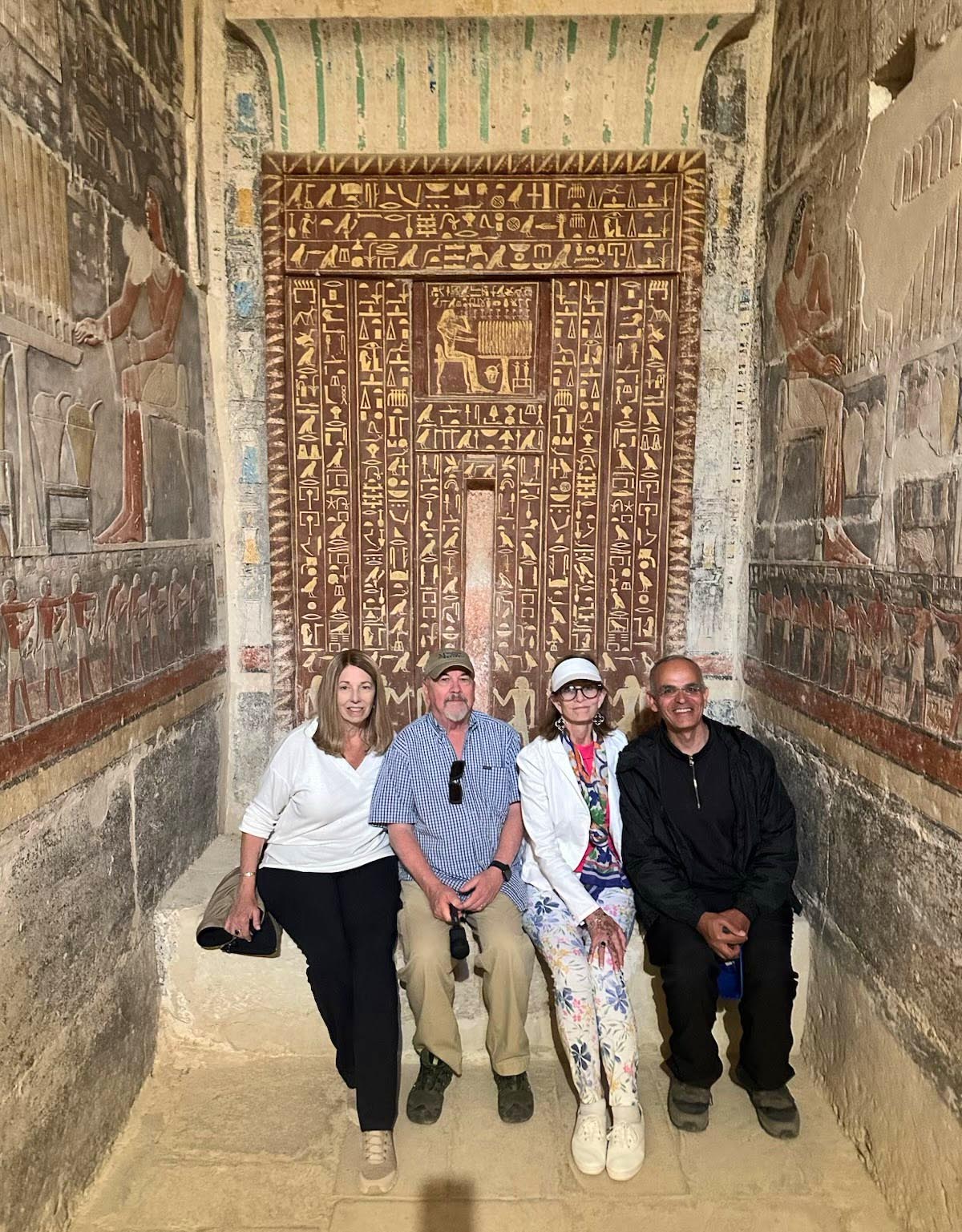
He took us to several with the most notable and well preserved being that of the chief of the treasury for the Pharaohs. The hieroglyphics were still covered in golden paint and carvings showed his incredible wealth waiting for him “on the other side”.
Later, after lunch, we visited Memphis, now covered by the current Cairo suburbs. What’s left is basically one small dirt patch with fragments of statues. Artifacts on the east side of the Nile have been buried now by today’s world. It is, after all, the side of the river for the living.

While disappointing, it still contains an incredible statue of Ramses found recently by a farmer.

Ramses was found face down in the mud, likely following a wild evening with the Pharaohs. Some things never change.


March 6, 2026

A late morning in Cairo. Our last before our flight leaves tomorrow morning at 3 AM back to the US meaning we have to leave by midnight. At least Ibrahim arranged for his driver, Maged, to pick us up at the hotel. No midnight taxi haggling.

We visited Garbage City, a Christian neighborhood (slum) where the residents recycle Cairo’s garbage. This area has become quite the tourist destination and is packed with traffic this Friday morning. Friday is now Egypt’s official religious service day for all faiths since Anwar Sadat outlawed Sunday worship activities 50 years ago. And, coincidentally, the Islamic holy day is Friday and the country is 90% Islamic. Go figure.

The neighborhood is filled with mid-rise brick and block buildings. On the rooftops are pigeon lofts where the residents keep, breed and race pigeons. I don’t know about messaging, but I would prefer homing pigeons to today’s electronic, inconsistent and sometimes dangerous internet babel.

At the top end of Garbage city is a Coptic Christian Church (“the cave church”) and a separate 20,000 seat auditorium built in another cave where Christian carvings from the first century AD were discovered. It’s also the location of a zip line and, seriously, what church couldn’t be improved by adding thrill rides. Zip lining for Jesus. Only a $10 donation.

And all the famous people have been here including the Pope and Mother Teresa. It’s a real hotspot for the holiest of the holies. And of course, the air smells of fresh garbage. Heavenly!

After our Sunday, errr, Friday Church services, we went, of course, shopping at Garbage City Mall and Outlet Center. Cheryl and Teresa bought handbags made from beer can pop tops and recycled Keurig Cups. There, I met a handsome young couple from London and convinced them I was from Canada. Eh?

Afterwards, we headed to lunch and MORE shopping at Cairo’s Old Bazaar. Its narrow maze of alleys filled with vendors hawking Middle Eastern motif stuff and hookahs. It was packed with the crowds spilling out into the adjoining vehicular traffic. The scratched and dented ocean of honking cars intertwined with shoppers.

Bizarre!


March 6, 2026

It’s midnight and we’re on the way to the airport here in Cairo for our return flight. Here are a few thoughts and observations on our visit :

1. Egypt is an amazing place and probably the most foreign country I’ve been to. It’s 90% Western; 90% Islamic; and 90% Ancient Egypt. All of these opposing forces somehow mesh together without causing conflicts. It’s a bit of an enigma. Like freeways with speed bumps. It makes no sense but it works.

2. I will never complain about traffic in Atlanta again. Well, at least for a day or two. In Egypt, it’s a chaotic storm yet, mostly, there are no accidents, only bumps and scrapes. In two weeks, hundreds of miles and plenty of time in motion, we’ve not seen one police car or firetruck roaring by, lights flashing, to the scene of a horrible accident. People here have some sort of psychic situational awareness that keeps them from serious harm. And all without troubling St. Christopher. And it helps that they are paying attention to the road instead of their cell phones when driving.

3. Egyptian people are almost all extroverted. They will talk with anyone anywhere even if everyone speaks a different language. They are all on the verge of laughing all the time, even when yelling at each other. We saw almost no homeless people. They all look out for each other.

4. The downside of this gregariousness is the Egyptian hustler. You cannot step out of a hotel or tourist site without being mobbed. Everyone wants to sell you something. And by “sell”, I mean negotiate. And negotiate. The motto on the national flag must read “Always Be Closing” or “Never Take No For an Answer”. Wish I could read Arabic.

5. Fun fact: English and western cultures use Arabic numerals. Arabic cultures use Indian numbers. As the old saying goes, “the sand is always browner on the other side of the pyramid”. Lesson learned: Don’t use hand signs to indicate numbers if you don’t know what you are doing. A peace sign is a 7, not an 8. Apparently, everyone in Egypt told me I looked great because I was using the hand sign for “80” to indicate my age. Once I finally discovered my mistake and used the proper hand sign, everyone was like, “oh”. So sad.

6. Speaking of lessons learned, be careful with what you say in Arabic. All week long I’ve been telling everyone that “I am Canadian” in Arabic. It turns out what I WAS saying was that “I’m a Canadian woman”. That may have been why I was getting so many smiles from the local dudes.

7. Egypt is and feels incredibly safe. No one except the police or military have guns. Which is a good thing around here given the traffic. Road rage with guns would be a mess here. OTOH, Egypt is located at the edge of the precipice. The Middle East wars are too close for comfort but Egypt has managed to keep that sort of chaos away. So far.


March 7, 2026

We completed our flight from Cairo to Paris. The first of three segments. Arriving at Cairo’s international airport at midnight (the busy time in Cairo), I was convinced we would face enormous crowds at the multiple security checkpoints. But, we got lucky, and there were few people in line. Getting through was easy.

Now we wait again. At least six hours’ worth.

These layovers are killers. Especially if you got up at 10 o’clock the previous evening to catch the first flight on time.

Next stop: Cincinnati. But not before visiting our future 51st state, Greenland. From 8 miles overhead.

Aloha, Nuuk!


March 7, 2026

Back in the US after a series of uneventful events. Things are going too smoothly after last week’s start of the Middle East war.

One more hop to Atlanta and I just read that last night 200 plus Delta flights were canceled due to weather. Our final flight is now delayed an hour.

If we get home as scheduled, it will be a 30 hour trip door to door and boy are my eyes feeling it.


March 8, 2026

Finally home with the usual hangovers. Exhaustion and time zone fog.

It’s great to be back home but, as any traveler will tell you, we look forward to our next adventure.

Until then, “Habibi, Baby!”

Countdown to a GEM

October 25, 2025


On November 1, 2025, The Grand Egyptian Museum (GEM) will be officially opened.

For three days, it will be inaugurated and shown only to dignitaries. Then on Tuesday, November 4, it will be officially opened to the public. November 4th is the anniversary of the discovery of King Tut’s tomb which happened over one hundred years ago in 1922. Needless to say, a short time ago given the temporal scale of this museum’s exhibits.

Located in Giza, on the western edge of the Cairo metropolitan area, it is adjacent to the Giza Pyramid Complex.

The museum has been under construction for over two decades and contains over 5.3 million square feet of permanent and temporary exhibition space with more than 100,000 archaeological artifacts including its most famous treasure, the golden mask of Tutankhamun. GEM is considered to be the largest museum in the world for a “single civilization”.

Our Teremar Travel associate, Egyptologist and Historian Ibrahim Morgan, has been sending us video updates which we will share here in anticipation of the opening in one week. He has been working with the museum for the last several years as the artifacts have been moved from the old museum in Cairo to their new permanent home in GEM.

Ibrahim is our expert in Cairo for all of our Egyptian travels. From Abu Simbel in the south, to Luxor, to Saqqara and north to Alexendria, Ibrahim provides a unique one-of-a-kind experience for our clients during their visits to Egypt. Ibrahim brings over 30 years of experience in the field along with a Master’s Degree in Egyptology. He is fluent in several languages and is considered an expert in reading hieroglyphics and will bring to life the stories contained in the stone walls of these ancient archaeological sites.

Ibrahim also has access to tombs and other locations that are not open to the public. And if you are looking for a magical experience, he can arrange a solo visit, just you and your family and no one else, to explore the inner chambers of the Great Pyramid of Cheops. Built 5,000 years ago, it is truly one of the Seven Wonders of the Ancient World.


October 26, 2025

In this video, Part 2, Ibrahim guides a tour group up the Grand Staircase, which displays 60 masterpieces covering four themes of Egyptian history: Kings and Kingship, Divine Buildings, Gods and Kings and last, The Journey to Eternity – the Great Pyramids.


October 27, 2025

Part 3 – Ibrahim continues his presentation guiding his group up the Grand Staircase which has 106 steps displaying 60 masterpieces covering four themes.

From this artifact depicting events over 3,300 years ago, Ibrahim explains:

“The Stela here shows the sun god, Aton, depicted as a sun disk with rays extending to a hand at the ray’s end holding an Ankh, the sign of eternity. He holds it to the nostrils of the worshipers to give them eternal life.

Akhnaton, King Tut’s father, created this new god, Aton, in response to the threats from increasingly powerful and insubordinate priests of Amon, the primary deity at the time. Akhnaton started worshipping Aton and built a new capital for him called Akhetaton which today is the city of Tell Al Amarna located in the middle of Egypt hundreds of miles away from Luxor, the existing seat of power then.

After Akhnaton’s death, the priests of Amon, who was the main god at the time and whose religion Akhnaton abolished, punished Akhnaton by chiseling out his image along with Nefertiti’s image, Akhnaton’s wife, and their oldest daughter’s image. The royal family returned to Luxor when Tutankhamun, Akhnaton’s son, became king.”

So, it seems, the more things change, the more they remain the same.


October 28, 2025

Video, Part 4 – Ibrahim continues his climb up the Grand Staircase on the way to the glass wall that overlooks the great pyramids. Here, he stops to describe the sarcophagus of Queen Meresankh III whose tomb was discovered at the base of the Great Pyramid of Khufu. This stone coffin dates back to the Fourth Dynasty.

Ibrahim explains:

“This sarcophagus is a unique one-of-a-kind discovery, renowned for its exceptional decoration. Weighing 50 tons, it was commissioned by the queen’s mother. But, at the age of 51, Queen Meresankh III became ill and died before her mother. Thus, the elder queen’s daughter is buried within it.

The mastaba tomb was found intact by George Reisner, a German-American archaeologist, almost 100 years ago on March 9, 1927. Inside the coffin, he found the skeleton of Queen Meresankh III, buried 4,500 years ago. From measurements, it was determined she was 4′-11″ tall.

Meresankh III was the wife of Khafre, a son of king Khufu. She had 8 children. An inscription on a doorway of the tomb records that Meresankh was buried 272 days after her death. An unusually long delay that suggests her death was unexpected and that time was needed to prepare her tomb.”

The second video below is a collection of photos from inside the tomb of Queen Meresankh III at the foot of the Great Pyramid of Giza.


October 29,2025

In this video, Part 5, Ibrahim continues his climb up the Grand Staircase and stops at the fourth section of exhibits called “Journey to Eternity”. Here, he points out a sarcophagus that was found in Medina many miles south of Giza.

As Ibrahim explains:

“This coffin is for Nitocris, the daughter of Pharaoh Psamtek the first. The coffin was found in Deir al Medina, a village where the artisans who built the tombs in the Valley of the Kings and Queens lived, on the west bank of Luxor. Her mummy was never found.

Nitocris was a nun. Before Christianity, the ancient Egyptians had nuns who were considered the divine wife of God. The nuns do not marry and must stay a virgin and they serve in the temple. Nitocris, divine wife of god Amun, was a nun for 70 years serving in Habu Temple in Luxor.”


October 30, 2025

Here, in Part 6 of our video series, Ibrahim continues his climb up the Grand Staircase heading to its finish at GEM’s Upper Level where the main exhibit galleries begin.

The Grand Egyptian Museum opened its signature staircase for trial as a vertical gallery on the 1st of December 2024. Containing over 60 artefacts, it is broken into four sections that mirror the life and times of the pharaohs: Kings and Kingship, Divine Buildings, Gods and Kings and last, The Journey to Eternity.

The design of this entrance and staircase allows visitors to gradually transition from the contemporary world back into the world of the pharaohs and reach the plateau level, the level at which the galleries are located, and visitors see the pyramids for the first time from within the museum.


October 31, 2025

This is part 7 in our series and the last. In it, Ibrahim reaches the top of the Grand Staircase where the permanent galleries are located. The staircase is the chronological route within the museum, culminating in the view of the pyramids at the top of the stairs. As Ibrahim approaches the glass wall overlooking the pyramids, to his left are the 12 main galleries displaying over 24,000 artifacts and to his right, is the complete King Tutankhamun collection comprising 5,398 pieces.

Ibrahim gathers his group around a model of the museum and explains:

“This model displays the full extent of the museum from the hanging obelisk outside the main entrance to the top of the stairs where we are now in front of the glass windows overlooking the Giza Pyramids. Between the museum and the pyramids, plans are for constructing hotels, restaurants, cafes and businesses. And they are planning to regrow ancient Egyptian plants like lotus, papyrus, sycamore trees, fig and palm trees. To provide access from the museum to the pyramids, a path with bridges will connect the two sites and electric carts will be available for transportation for the museum visitors.”

The official opening of the Grand Egyptian Museum is tomorrow, Saturday, November 1, 2025 and opening ceremonies will be broadcast live on TikTok starting at 6:00 PM local Egyptian time.

Welcome

Teresa and Mark Hildebrand have been avid travelers since the 1970’s, visiting over 60 countries and still counting. They met in flight school in the 90’s, obtained private pilot licenses, bought a plane and have sojourned together ever since. 

Teresa had a 41 year career in travel, starting in the hotel industry, and retired from AAA Travel where she was Vice President of the Travel Agency.  She has been on travel advisory boards for Royal Caribbean International, Walt Disney, Trafalgar, American Tours International, and Hertz Corporation. 

Mark worked in the architectural manufacturing industry for years after graduating with an architecture degree from Georgia Tech. His days spent in architectural history courses ignited his interest in exploring the world and experiencing first hand the historical manmade treasures.

Teresa and Mark enjoy traveling off the beaten path and have collected unique experiences in France, Italy, Spain, Kenya, Egypt, South Africa, India, Cuba, Galapagos Islands, Southeast Asia and other exotic locations around the globe.  They have many requests from adventurers to experience the same kind of travel they enjoy, so they have had the pleasure of taking small groups and families to enjoy luxury trips like Safaris, Taste of Italy and Villa Stay, Tanzania and Kilimanjaro Climb, Footsteps of Mandela, Palaces of India, and many land/cruise holidays.

They both welcome you to this travel blog that shares some of their adventures and how unique travel can be.  They continue to explore prior destinations, and seek out new and emerging gems to quench their travel thirst. 

Antiquities of Egypt and Jordan

February 17, 2017

En route to Cairo on a 787 Dreamliner (with WIFI) that is in its second day of service. New features include passenger windows bigger than normal that can be electronically blacked out by the flight crew. They are currently set to a deep cobalt blue. Nice effect as the setting sun streams in. Kind of like stained glass windows. The plane still thinks it’s in Seattle where it was manufactured explaining why the location shows Paine Field as my WIFI location.

February 18, 2017

In Paris. For 3 hours. It’s nice to be back in civil civilization. What’s not to like about a country that is better at making love than war. Viva la France.

February 19, 2017

An incredible introduction to Egypt and the pyramids. Teresa arranged for one of the top professional guides, Ibrahim Morgan, to provide private access to tombs unavailable to the public. We were the first of the day to enter and climb into the heart of the Great Pyramid of Giza in the early morning. Quiet, eerie, dark, hot and steep. And thrilling to be alone with no guides or anybody else in such a sacred and historical place. We gave our greetings to the vanished pharaoh and headed back down the steep and narrow tunnels.

Exiting out into the cold morning air, it was apparent why Ibrahim was in such a rush to get us into the site. In front of the pyramids were now hundreds of tourists all taking selfies. A strange setting and sight. Later, Ibrahim took us to one of the queen’s tombs excavated in the 1920s by a team from Harvard not open to the public. Inside were painted hieroglyphs detailing the life of this lucky sister wife. She was a big, big fan of her daughter apparently. And liked furniture. Her husband, the pharaoh, was a fatty. A sign of wealth and power of the times. Too much beer. Ibrahim, fluent in hieroglyphics, made the adventure even more awesome. The entrance to the queen’s tomb is a short distance from the large pyramids.

February 20, 2017

Was picked up early in the morning by Ibrahim. The air was cold and thick with smoke and fog. We passed thru several security points on our way to the Egyptian Museum in downtown Cairo on Tahrir Square, the central location of the uprising in early 2011. At each check point the driver would say something sounding like “Kennedy” to the heavily armed police. Not having learned from cats, curiosity got the better of Teresa and she asked what they were saying. “Kennedy”, they explained, was Arabic for Canadian. They were telling everyone we were Canadians just so we could “stay out of trouble”. I quickly proceeded to learn how to say “I’m Canadian” in Arabic. “Ahna Kennedy, Ahna Kennedy, Ahna Kennedy” I repeated in the back seat.

We arrived at the museum and once again were first in line followed by a teaming mass of selfie stick holders. We entered and went thru security. “Ahna Kennedy”, I said to the guard.

Smiles.

Good.

The museum is huge and should take several days to really see. Ibrahim, an absolute expert, quickly guided us in to show us the highlights and explain the incredible history. Statues, chariots, furniture, papyrus scrolls thousands of years old flowed past us on our trek. Absolutely incredible and priceless treasures. Glass eyes hollowed out with accurately depicted pupils gazed at us from the statuary. Lifelike and untouched.

We finally reached the top floor, the home of King Tut, the boy king. Shiny golden funeral masks, gold sarcophagi, gold jewelry covered with lapis lazuli. Golden chariots, chairs, chess boards. Toys. Where was the golden Xbox? The museum was looted following the 2011 uprising. It’s incredible that the Tut treasures were not taken. I guess hauling out hundreds of pounds of gold is a bit much for looters. Or maybe fear of a curse.

On our way out, we stopped by the mummy room and roamed thru the dark shriveled up bodies. Pharaoh Ramesses II stared at us with eyes stitched shut, arms folded against his tiny chest. “Ahna Kennedy”, I told him. Creepy, eh?!

Finished with our tour in downtown Cairo, we headed back to our hotel located at the entrance to the pyramids – the Mena House. We took time on our final night to tour the property. The historic Churchill Suite (where Winston Churchill stayed) is gorgeous. Feels like you can reach out and touch the Great Pyramid of Giza from the private balcony. Gilded glory throughout with 2 marbled bathrooms. Grand luxury in this historic palace!

A final dinner overlooking the great pyramids flooded by light in the chilled night air.

February 21, 2017

On the way to the airport, heading south to Luxor. The freeways, while technically 4 lanes in each direction, are in reality 12. Or 20. It just depends on how closely the Cairo drivers like to get to each other. It’s clear the Egyptians are good dancers. An interesting observation – this is where all the 1970s Chevy Vegas went to in their afterlife.

After checking in on board the Nile riverboat Oberai Zahra, we spent the afternoon exploring the luxurious Luxor Temple complex. The seat of power for thousands of years for the Pharaonic dynasties, the temple combined religious and governmental operations – a combination of New York and Washington for the times. Each Pharaoh added on layer after layer until the Egyptian empire died out as the Roman one rose. The Luxor Temple is on the east side of the Nile. The side for the living. The west side is reserved for the dead. Tomorrow, we head west.

February 22, 2017

In the early morning we headed out to the Valley of the Kings, nearby on the western side of the Nile, which in ancient Egypt was reserved only for the dead. The Valley of the Kings is home to 62 pharaoh tombs that have so far been discovered . The last was 100 years ago, the tomb of King Tut. The Great Pyramids are older but were difficult to guard against grave robbers. It was decided to move the capital of the kingdom south, up the Nile River, and to build the future tombs in a more discreet, less flashy style. You would think a 500 foot tall gold capped pyramid would just blend in. But the locals were a bit more observant. Anyhow, after much heated debate, the high priests and pharaoh club members came up with the plan to move to Luxor. Seen below is the entrance to King Tut’s tomb. His mummified body still inside, one of the smaller tombs given the short time he reigned.

Scenes from sailing on the River Nile.

February 23, 2017

The next day, we visited the Temple of Hapchepsut, the only female pharaoh in thousands of years of ancient Egyptian history. She apparently won the popular vote AND became the ruler. Talk about breaking through the stone ceiling. The temple was where she was embalmed, a process taking months, before she was transported to her burial tomb on the back side of the mountain in the Valley of the Kings, which we visited yesterday. Only males were allowed to be pharaohs. Hapchepsut, or “Happy” as she was known by her friends, decided she wanted to be a pharaoh. To get the part, she would dress like a man, walk like a man, talk like a man. She wore a fake beard and colored her skin orange, foreshadowing long future events. Her mummy oddly enough was found wearing a ring of keys and lace up boots. In her burial tomb could be heard the faint sounds of K. D. Lang.

After a long day, we stopped at the local Kentucky Fried Chicken. Shouldn’t this be called Egyptian Fried Chicken? These things are everywhere.

February 24, 2017

We continued sailing south towards Aswan, the Nile wide and calm in the early morning haze. At breakfast on the lowest deck, the ever soothing spa music was interrupted by a loud metal clank and screaming. Surprisingly, outside the window, popped up two young Egyptians holding up table cloths. Like a Remora fish, their small wooden skiff had tied on to the side of our boat. I headed to the top deck to start negotiations.

After introductions, “Ahna Kennedy”, the product show began. There was a nice tablecloth with 10 napkins, handmade with Egyptian cotton … ignore the made in China label, a bright blue robe with hieroglyphics, a black thing covered in gold sequins … item unknown, a Third Reich swizzle stick. They had an extensive inventory and a very strong arms. Suddenly the items in plastic bags were getting cannon-balled onto the top deck 30 plus feet above the river surface. Other boats joined the sales melee. Shouts of “mister, mister” filled the air. We were approaching quickly a set of narrow locks; our boat squeezing into the tiny wooden boats attached 30 feet below. A minute or two away from our baseball armed salesmen being crushed. Fierce haggling began. “How much?”, I yelled out. “Egyptian pounds or dollars?” the local Sandy Koufax replied. Sixty seconds away from being crushed and we are now engaged in a conversation about currency exchange. “Dollars”, I yelled back. “For you, 100 dollars”, he replied. “No way. You are about to be crushed. I will give you 10 dollars.” There is no such thing as low balling when you are seconds away from being crushed. “80 dollars”, he replied, driving a hard bargain and a short life. “20”, I said. “60”, he yelled back. “No, 20. That’s all I’ve got.” “40.” “No, 20.” “OK. 20”, the very motivated seller answered. I put the money in a plastic bag of an unpurchased item and dropped it over board. Sudden death on the Nile leaves little room for lengthy negotiations.

Pulled ashore this afternoon in Edfu. Teresa and I got a taxi to take us to the local Waleedmart to pick up some supplies. Busy little town.

February 26, 2017

Made is back to Cairo to spend the night before heading to Amman in the morning. Took a trip into Old Cairo to visit the market, or bizarre as it’s more appropriately known. Sunday afternoon and busy, the market was very crowded with very pushy, and sometimes creative, salesmen. “Meowing” here … “How can I take your money?” there. While shopping, who should we see but Cheryl Davis. Shopping no less! Small world. Big bizarre.

February 27, 2017

Arrived in Amman, Jordan, and picked up a rental car. The car, a small Nissan SUV, looked like new luggage just arriving on the baggage carousel after its first trip. The body was covered with scratches, scrapes and dings. Driving looks like it’s going to be a contact sport here.

Headed south into the flat west Texas landscape on the aptly named Desert Highway. Of course, every road here is named Desert Highway much like all the Peachtree streets in Atlanta with one exception. There is actually desert here.

After an hour I got pulled over by heavily armed guards. I rolled down the window to give a cheerful greeting of “Ahna Kennedy”. The burly guard approached the car. After taking a quick look he scowled at me and went “Pffft” and with a flick of his hand, sent me on my way, ego intact but severely bruised. Little does he know how dangerous we Canadians can be, eh!

Spent the evening climbing a mile down the candle lighted canyon entrance of Petra to the Treasury, the scene of many movies, most notably Indiana Jones. Descending down, the canyon walls narrow until they are only 10 – 20 feet wide with canyon walls over 100 feet tall. The night sky bright with stars in the black slits overhead. On arrival to the Treasury, people seated themselves in the sand to listen to a concert of Arabic flute and string instruments. Magical … the only thing missing were djinnis.

Petra is an ancient city located on the Silk Road and is known for the temples carved into the rock walls that line the canyons. The entire ancient city once housed 40,000 people and had an advanced water utility system. We head back in the morning to look during the daylight and begin exploring other temples, canyons and sites. From start to finish, Petra is over six miles long and has many side trails and canyons, too much to see in one visit.

February 28, 2017

We spent the day in Petra, the ancient capital of the Nabataean kingdom. At the entrance canyon we hired a Bedouin tribesman with a thick Australian accent as a guide named Abdullah. Riding horses, Abdullah took us down describing the various tombs and elaborate system of pipes and flood controls that were built to protect the city. At the bottom we entered at the Treasury where the previous night we enjoyed a concert in the dark. After a brief stop we continued down the canyon toward the city center.

Both sides lined with tombs and caves built into the steep and colorfully striped cliffs. The trail turned into a wider dirt road, now lined with gift shops, a fortuitous coincidence for sure. Shops sold spices and incense, frankincense and myrrh, and free WIFI. Surely this was the spot some years ago three travelers stopped to grab a quick gift on their way west for a baby shower.

One of the highlights of Petra is the monastery located at the top of a mountain a few miles away accessible only by a climb up steep stairs carved into the cliff face. Our Bedouin knew a Bedouin who knew a Bedouin who owned some Uber Mules. Quicker than you can say “Holy Jehoshaphat” two Bedouins with three Uber Mules pulled up on the side of the road. Climbing on board, we headed to the foot of the stairs. By late afternoon we arrived at the monastery after hanging on our mules as they climbed the stairs, one misstep and a certain death plunge to the rocky floor far below. At the top, a view westward of the Jordan Valley and beyond, Israel v. Palestine.

March 1, 2017

Before heading back to Amman, we spent the morning shopping in Wadi Musa, the village located outside the entrance to Petra.

March 3, 2017

Early morning arrival in Paris for a change of planes back to Atlanta.

March 4, 2017

Back home and jet-lagged. Awake. Up at 5 AM. Make coffee. Sit at my desk. Turn on PC. What’s that? Live, from 250 miles up, is the Nile River flowing north and scrolling across the screen. A sharp contrast of green against gold in a cloudless sky. Home to incredible history and people.

And a real bargain now since their currency was devalued in November by the IMF. Another win for “austerity” but in reality a burden for the people of Egypt. The local currency went from 3 pounds per US dollar to 20 almost overnight. A deal for travelers and at a time when many travelers are not visiting. Egypt’s economy relies heavily on tourism. If you’ve ever thought of visiting, now is the time. We had the best guides, especially our new friend, Ibrahim Morgan. I would return in an instant if the instant was a 36 minute trip like the International Space Station takes and not the 36 hours it really does much closer to earth. And if you go, remember to tell them “Canada” sent you.

Kilimanjaro Journal

February 3, 2016

Delta Flight 72 left Atlanta on time today, February 3rd, heading towards Amsterdam. I am on my way to Tanzania. Arusha, Tanzania, to meet up with Cheryl and Kurt as we begin our climb of Mount Kilimanjaro. The flight lands in Amsterdam where I will catch a KLM flight for the final segment. Each leg of the trip is 8 hours of flying time. At takeoff, we headed into the sunset, clear, red and beautiful. As the sky darkened, we passed over Chattanooga, the city lights visible below.

Mount Kilimanjaro is the tallest freestanding mountain in the world. Now an extinct volcano, it formed on the eastern edge of the Great Rift Valley that is splitting the continent of Africa in two. The mountain itself consists of two peaks, Kibo and Mawenzi. Our plan is to climb the Kibo Summit which rises above 19,000 feet. Kilimanjaro was first climbed in 1889 by a German geographer named Hans Meyer. Ever since its discovery by the European explorers, Germany and England have been making colonial claims for this territory. Eventually, it was mapped out by the Germans to become part of Tanzania and not part of Kenya as England was seeking. The British demanded the border be drawn in a straight line from just south of Mombasa to Lake Victoria resulting in Mount Kilimanjaro just inching into Kenya. The Germans won and the boundary between Tanzania and Kenya was drawn taking a turn north at the mountain before heading to Lake Victoria.

Reports of a mountain covered in snow at the equator was considered as a joke when first sighted by Europeans in the early 1800s. People living at the foot of the mountain at the time knew nothing about snow and believed it to be “powder” that was put there by their god to protect the areas below the summit. It is our mission to, once and for all, settle this debate and return with a pronouncement, “Powder” or “Snow”. God help us if it is “powdery snow”.

Arrival in Amsterdam

February 4, 2016

Landed in Amsterdam after an uneventful flight. We crossed the English Channel on final approach below the cloud layer. The shoreline a string of lights. Outside, it is dark and wet. Cold too, I’m sure. This is Holland in winter. The Dutch love their cloudy miserable weather. As usual, only 4 hours on board were quiet and dark enough for sleeping. International flights have so much activity before you can finally rest. Would be nice sometime if they just handed out lunch bags on boarding and then turn out the lights so you can get more rest. I don’t think the flight crew would object much, either.

Arrival in Arusha
20160204_163625

Just arrived in Arusha on board KLM. Flew over the Sahara and Karthoum, Sudan. The colors and shapes of the desert beautiful from this altitude. My seat mate, a young man in his late twenties, also heading to Tanzania to climb the mountain. He had just climbed Japan’s Mount Fuji in the past few weeks. He showed me pictures of the statue at the summit … in a hurricane. Hoping we have better weather for this climb. We talked for a while before he told me he is a B-52 pilot stationed in North Dakota. Incredible. What a lucky man I thought to myself until hearing the details of what piloting a B-52 really entails. Flight controls that you have to wrestle just to turn or climb. Day long journeys with no toilet aboard. Good planning! And original equipment from the 1950s that a good solid whack from a hammer usually fixes. Yikes! Details I probably would be better off not knowing. Sleep tight, America!

Kilimanjaro International Airport

11 o’clock at night. What a mess. Thank god Teresa had me get a visa (required) before entering the country. I am apparently only 1 of a dozen people on the flight who did this. I sailed quickly through Customs and Immigrations and found my luggage. A line of over one hundred people formed for those without a visa. It will be a long time before they all make it through.

Headed outside the terminal building to a line of a hundred or more locals to find my taxi driver. “No, I am not Mr. Schneppen.” It is very hot but not surprising. Found my driver (she had a sign with Hildebrand spelled correctly, something impossible in the US) and headed to the taxi. We get in the car and she heads out of the parking lot and she’s “DRIVING DOWN THE WRONG SIDE OF THE ROAD! Oh! That’s right, sorry.” We pass a slow line of cars blocked by a tractor driving at a walking pace. She yells out the open window, “Mjinga”. I ask her what that means and she tells me “idiot”. It’s Swahili. And it’s a new word for me to use. I’m now like a two year old who just learned a new word. Mjinga! Mjinga! Mjinga!

After an hour driving down a very busy two lane highway, we turned left down a pitch dark dusty road to the Lake Duluti Hotel. The room has a bed with Mosquito netting and a ceiling fan overhead that has two settings. Hurricane and helicopter. You have to duck down when getting into the bed to avoid being Vic Morrowed. In the middle of the night, the ceiling fan started to make noises like a digeridoo. “FEB bru ary, FEB bru ary, FEB bru ary” it seemed to be calling. (Hallucinations already?) A strange cricket/anaconda like noise started in a closet. I did not check it out. Some things are best left unknown.

Morning in Arusha

February 5, 2016

After a quick breakfast (“Scrambled eggs, please, and use the whole egg, not just the white”) and coffee I checked at the front desk to see if they could help me purchase a local cell phone sim card so that I will be able to text back to Teresa to keep her updated on our progress. The hotel manager, named Goodluck, offered to walk me into the village to their Vodaphone shop.

We headed out of the hotel grounds past the guard shack and took off down the mile long dusty road to town. Cars and motorcycles (more like scooters) whizzed past inches off my right shoulder from behind flinging up rocks and a cloud of dust. Unnerving. Goodluck stayed to my left. It was a clear morning and Mount Meru was visible straight ahead. Kilimanjaro’s little brother mountain, still the second highest in the country.

After a bit of back and forth in Swahili, I handed my cell phone to the Vodaphone rep. He put the chip in, I signed something, and I was good to go. I also asked to have money put into the cell phone using their M-Pesa system, a means of paying using text messages. We headed to a local 7-11 where I made a deposit equivalent to 20 US dollars.

On the way back to the hotel, Goodluck offered to show me the local market getting ready for the next morning (Saturday morning) market day. Cleanliness standards were somewhere between Kroger and Publix. Lots of familiar vegetables and fruits; okra, onions, green beans, peas, etc. But this is real food, not GMO or unblemished. And absolutely no coupons so checkout lines are much quicker.


After returning to the hotel, I explored the property waiting for Cheryl and Kurt to arrive (already on safari for the prior two weeks) with their Yale tour group. The Lake Duluti Hotel is a beautiful property on grounds with a garden overlooking a lake. Around 2 in the afternoon, Kurt entered the lobby while I was sitting nearby using the WIFI signal. Cheryl and the rest of the group followed shortly. Around 4, our tour operator, Ultimate Kilimanjaro, arrived and briefed us on some of the details of the climb.

Arrival in Moshi

Just arrived in Moshi, a 2 hour drive east of Lake Duluti. More like a 2 hour game of chicken. A two lane highway filled with double and triple tractor trailer rigs going 1 MPH and cars passing head long into each other if not using the shoulder instead. Anyhow, we got to the hotel in the downtown section. A quaint lodging in the “shabby chic” style for lack of a better descriptor. I had a fit when I found out there is no elevator in the hotel and my room is on the third floor. Really, do they expect me to carry my bags up all three floors? I was exhausted at the end of the stairs.

The Start of the Climb

February 6, 2016

We leave Moshi this morning to start our climb after lunch. Weather in town is clear and cool. The coolness will definitely not last. The first day of the climb is about 4 km on a jungle rain forest trail. Hoping (probably beyond reason) that “rain forest” is just a euphemism for “dry and cool forest”. We shall see. Having breakfast and waiting on Cheryl and Kurt to show up. Our two guides, Ewand (the professor) and Barako (self described president of the mountain) are due in an hour. Accommodations are a step up from camping and luxurious past this point. Communications going forward via text or Facebook are dubious at best. Enjoying the fresh brewed hot water and powdered coffee. Courage!


On our way. We’ve been briefly introduced to the 14 staff/porters by our 2 guides. A total of 16 people to help three of us reach the summit. Hope it’s enough. There is much excited chatter on the bus and plenty of (probably appropriate) laughter. The summit is clear with some snow and a cap of clouds. It looms immediately to our right and stretches to the top of the bus windows. An incredible sight. I pity the fools who think they can climb that.

An Hour from Lemosho Gate

We are driving around the western flank of the world’s largest freestanding mountain. An extinct (hopefully) volcano. Farms and sunflower fields line both sides of the paved highway. To the left in the distance you can see yesterday’s Mount Meru and smaller volcanic vents. The summit of Kilimanjaro is forming its own weather. Angry marshmallows now conceal its upper half. We are anxious, not knowing what to expect from our upcoming experiences. The crew is quiet and contented following their breakfast and candy bars that Cheryl Davis handed out.

A Short While Later

Well that didn’t take long. The pavement ended. We are now rattling along a desert dusty road. Through breaks in the dust clouds you can see miles of open plains stretching eventually north to Amboseli. The bumps of volcanic vents are everywhere. Everywhere. Just before the end of pavement, we passed a parade of hundreds of motorcycle taxis. Could be some sort of protest action. As we get close to our starting point we are passing through carrot farms and cultivated timber forests.The trees are conical fir trees with pine needles that hang off the limb and look like groomed horse manes. They turn silver in the blowing breeze. The fir trees look out of place. Like something in the Pacific Northwest. We have arrived.

Arrival at Mkubwa Camp

(Sunset) – We reached Mkubwa Camp after a 4 hour trek mostly straight up along a narrow trail thru the dense jungle. We are at the 9,000 foot elevation. Our site in the camp consists of 2 geodesic tents for Cheryl, Kurt and me, a mess tent and a kitchen tent. There are a half dozen other guided groups at the camp. Toilets consist of bushes or a tented mini toilet. Luxurious. We are told tomorrow we will leave the jungle behind as we climb to 11,000 feet.

Sunrise at Mkubwa Camp

February 7, 2016

After dinner last night, we were briefed on our next day’s plan. Heart rates and oxygen levels checked, we headed to our tents to sleep. It was 8 o’clock and 2 hours after sunset. The camp, however, remained a beehive of activity. Chattering voices in Swahili and some other languages continued for an hour or two and then suddenly, complete silence. At 9,000 feet the cold sets in quickly and I was forced to improvise. The pillow I had created from a nylon bag was too cold to sleep on. I wrapped it in a flannel shirt. Underwear is fine for sleeping in at the equator. But not at 9,000 feet. On went the fleece pants. The Diamox we were all dosing ourselves with made me appreciate the plastic bottle I brought.

Sometime in the middle of the night the camp was awakened by loud sounds that I can best describe as growling frogs. Hundreds of loud growling frogs. Coming somewhere from either just outside the tent or overhead or both. The growling horde continued for a little while and then suddenly stopped in unison. All quiet except for the muffled voices coming from nearby tents. A reply from far off was heard. “We are growling frogs too”. Quiet briefly, then our team of growling somethings replied back. This went on for a little while and then stopped. What were they? Frogs? The Monkees? Aliens? And what were doing? Issuing warnings? Threats? I didn’t leave the warmth of my sleeping bag to investigate. I didn’t hear the sound of zippers so I knew my fellow campers were not investigators either. Some things are best left unknown.

The Hike to Shira Camp 1

We have arrived at Shira Camp 1 in the late afternoon after leaving Mkubwa Camp (also called Big Tree Camp) at 9 that morning. The trail headed east thru the jungle with our target a seemingly short 5 miles east towards the summit and an increase of 2,000 feet elevation to 11,500. It started easy enough but was soon descending and climbing back up through several valleys.

At the 10,000 foot elevation we left the rain forest and entered the next ecological zone called moorland. The large jungle trees were gone and plant life took on a shorter more subtle desert like quality. The trail started to become more difficult with steep drops and climbs over rocks and boulders. Progress slowed considerably.

We were expected at our new camp by 1 for a hot lunch. As we gained altitude the views to the north opened up towards Kenya and Amboseli. After 2 miles we were becoming very exhausted. Breathing was difficult with the strain especially now that we were over 10,000 feet in altitude. We were told our goal was the top of ridge where the Shira Plain starts about a mile away and up another 1,500 feet. This was the most difficult climb and we were already exhausted. Every step up was a challenge given the steepness and rockiness.

It seemed like it took a few hours but we finally reached the ridge. Another 2 miles east on relatively flat trail and we would be at our new camp. Kurt noticed dark storm clouds in that direction as a light rain began to fall. We put on our rain gear and headed off. In a short while the rain turned heavy. The sloping trail turned onto a river of muddy rapids. I was starting to find out that my so-called rain gear was, in fact, not. I was getting soaked from the top of my head to the inside bottom of my hiking boots by the cold rain. That’s when the hail and lightning started. Our options were few. Continue on towards the camp still two miles away and hope that a lightning strike ends our misery.

We finally made it to camp and found our mess tent. We entered and took off what soaked gear we could. The floor of the mess tent had rivulets of muddy water flowing across and rain dripped from the tent’s roof. Cheryl and Kurt insisted I take off my drenched shirt to avoid hypothermia. In their day pack they had a dry fleece shirt. They are always prepared and have previous experience from hiking the Grand Canyon. The dry fleece really helped.

One of the porters arrived with lunch. Toasted cheese sandwiches and cucumber soup. We ate and warmed ourselves up while avoiding the drips of water. After eating we headed to our tents thru the pouring rain. Covered in mud I tried to remove my clothing outside to keep the tent’s interior dry. I put on my dry fleece pants from my dry bag the porters had delivered when setting up camp earlier in the morning. They have a challenging job tearing down camp in the morning and racing past us on the trail to get the new camp set up by the time we finally straggle in. I laid down on the sleeping bag pad and crashed.

I woke up a few hours later to the sound of footsteps next to the tent. The rain had stopped and one of the porters, Mosha, had rounded up my wet and muddy gear and cleaned it and stretched it out over bushes, guy wires and tent roofs to dry. This was greatly welcomed. At this altitude the air can dry things quicker than you would think. Stretches of sun through the broken clouds could now be seen on the western flanks of the summit still miles off towards the east. Kilimanjaro itself was wrapped in clouds.

To Shira Camp 2

February 8, 2016

Morning and the entire summit of Kilimanjaro is briefly visible in the cold saturated air. The south face is covered in new snow. An effect one assumes from our icy encounter yesterday. Briefly, I say, because within 15 minutes the summit is covered again in clouds. Our waiter porter says to me as he is wiping off the mess tent’s wet dishes that it looks like it will be a rainy day. Not good to hear especially in light of the fact that the hot water is not yet ready for the coffee powder.

New lessons are quickly learned every day here. To hell with sensitive electronics. They can go in porter bags. Clothing layers must be packed in the bag I carry. The only thing yesterday that had an effective rain proof cover. Ex-Officio underwear never dries. Not “quickly” as their marketing materials would have you believe. We prepare to slog on.

We departed Shira Camp 1 at 8:30. The trail headed out gently up the moorland towards the east. After a short while we crossed the first of several fast flowing rocky creeks. The trail was pretty level with occasional climbs up and over ridges. After an hour we stopped to look at Cathedral Rock on our right towards the horizon. Our original plan called for following the trail to Cathedral Rock but the trail would have taken us through a swampy area now filled with runoff from the rains. Cheryl Davis, Kurt and I quickly vetoed that idea.

We continued our trail eastward for another hour. Dark storm clouds formed ahead. The first drop of rain is all it took for us to quickly encase ourselves in any possible water proof items. Ponchos, water proof pants, back pack covers. We trudged on swaddled in plastic.

In a little while ice was falling again. At our elevation of 12,000 feet we all concluded this was more likely sleet. The air seemed cold enough. The lightning and thunder 30 minutes later made me wonder, again. The trail turned steep and rocky. Rain water flowed between the rocks. Clamoring over the wet and slippery rocks was tough and I struggled for breath due to the altitude and effort.

Up and down over several ridges we finally spotted our destination. On top of a ridge of boulders was Shira Camp 2. A large green roofed ranger’s station was clearly visible along with 2 fenced in weather stations. The final climb to the camp was over big rocks. Difficult. We reached camp and tried to catch our breath in the ever thinning air. Thunder rumbled loudly from a lightning strike nearby.

The Test Climb to 15,000 Feet

February 9, 2016

Weather conditions have been terrible since our arrival at Shira Camp 2 yesterday. At midnight last night, the skies opened up and torrential rains fell accompanied by high winds until day break. Temperatures were so low I slept in multiple layers of clothing. Huddled in the sleeping bag starting at 8 in the evening I remained at least comfortable. A luxury.

When the first drops fell I wondered whether it was ice falling. As the storm’s ferocity increased, I realized it must have warmed above freezing. I got only four hours of sleep due to all the commotion outside and worried as what was coming up was going to be the toughest day on our schedule short of Summit day still days away. Today would be a test day which would require us to climb 3,000 feet to 15,000 feet, an elevation that threatened severe elevation sickness effects along with the most mileage so far, 8 miles. All of this in miserable weather.

I got out of the tent at 6 in the morning to a light rain. It was completely fogged in. Visibility was no more than 100 feet. We ate anxiously and followed it up with the pulse and oxygen test. My heart rate was 104. Anything above 100 prevents you from climbing. I explained that I had just been wrangling with my day pack to put on the water proof cover. I sat down and relaxed and the rate dropped to 93. Passing. Oxygen was 91, good. We headed out.

I was dressed in multiple layers and water proofed as much as possible. Light rain was falling and visibility was low due to the fog. Bodies of other Mjingas moved slowly, dark hooded figues in a ghostly scene.

We started to climb. Slowly, slowly our guide said softly. Poalee poalee in Swahili. One step then another. Like moon walkers in a grainy black and white film. The climb was continuous. Gradual at first and then steeper and steeper. Silhouettes of large rounded boulders could be barely seen through the mist. Only four hours before we could enjoy a box lunch at our halfway point. It was miserable. If it was clear, I’m sure the view would have eased our struggles.

Two hours in we hit a crossroad. Signs pointed to various destinations. Our destination, Lava Tower, pointed straight ahead. In a hundred yards the trail dropped between two massive boulders. A narrow stairway descended into the cold deep haze. At the bottom the trail turned left hugging a stone cliff. To our right the cliff dropped off uncomfortably quickly to the unseen. Thankfully for once the thick fog was an ally. I would not have wanted to know how far down things went.

The trail eventually merged into what appeared to be a tilted table strewn with 10 foot boulders. Finally a ridge with a dozen human shapes moving to the left appeared ahead. As we approached this busy highway of fellow thrill seekers things got thrilling. The icy winds picked up to at least 30 MPH blasting us with fog and ice particles. My poncho, held together with four flimsy snaps, blew apart and turned into a blue sail obscuring my vision. I tried to find a place to take off my backpack and re-secure the poncho. I was getting drenched, again, and my face was quickly becoming frozen. I found my balaclava in the backpack and put it on. I was able to put the poncho and backpack back on but it took all my effort. I was out of breath. An easy condition to find yourself in at 15,000 feet. Just amazing how thin our atmosphere really is.

We continued our march east to the Lava Tower along with groups of Brits and Japanese (properly attired in the best Outdoors Magazine gear-of-the-month collection) I can only say I was warned by Teresa that I did not have the proper gear. She was right and now I was struggling more than necessary because of it. I thought maybe there will be some rain or snow but I was certainly not expecting to be playing an extra in the new Ice Station Zebra remake.

We got to our lunch spot. The rain and frozen ice was unabated and we as a group decided to skip the visit to Lava Tower and backtracked to our next camp, Moir Hut. Back across the cliff wall and up the narrow boulder crushing steps. We turned right at the first trail crossing of the morning. Two hours ahead through the frozen fog was our new camp site.

We followed the trail down paths strewn with slippery little rocks. After fording several flooded streams we emerged into a fog filled flatland. As we continued into the fog a yellow shape started to take form. It appeared to be a large domed community tent. We had reached Moir Hut and were now back to 12,000 feet elevation. The yellow tent was a competitor’s tent. Our meager camp site was just forming out of the haze beyond.

I found my tent and climbed in and crashed. I slept for an hour and when I climbed out of the tent to find that the fog had lifted. There was sunlight. Unbelievable. The camp site was at the bottom of a lava canyon with walls climbing over a thousand feet. I found my box lunch and headed to the mess tent. I ate the little chicken wing wrapped in foil along the two orange slices. I thought how lucky that Cheryl, Kurt and I did not suffer any of the effects of altitude sickness (headache, vomiting, dizziness, disorientation). We had passed our test. I craved a coke.

Around the North Face

February 10, 2016

The morning started out with the summit of Kilimanjaro visible and so close that Uhuru Peak was no longer visible, hidden by the edge of the surrounding plateau. The western face was covered in freshly fallen snow. It was partially sunny and very welcomed. From the top of the sides of the lava canyon fog spilled down. A beautiful and mesmerizing sight.

Our path today took us up and out of the lava canyon we had overnighted in. The initial climb was about 1,000 feet. At the top of the ridge we took a break and talked to a couple who were following the same trek to the summit. A couple in their early 60s. They told us that major flooding was occurring in the south of Tanzania. No surprise given the weather we had been experiencing. Our guides said the weather was different now due to global warming and dry seasons are now wet. We are supposed to be in the dry season.

The trail continued across plains of lava rock. Gradual descents and climbs. In the flatter areas, the rock was broken up into flat sheets and sounded like we were walking on broken dishes. You could hear other hikers in the group clinking their way forward. We came across what appeared to be a road of well cut cobblestones. Apparently a different type of lava that had formed and bubbled up before cooling long ago.

We decided to break for lunch and along the top of the next ridge could be seen two large yellow dome tents, the same ones for the couple who we talked to in the morning following our initial climb out of the valley. Their tour guides are from Tusker Trails. A nice setup and a hot lunch on the spot for the lucky couple from Canada and Durbin, South Africa.

We slinked through their camp and made another 100 yards before settling down among some larger rocks. At last a break and lunch. A cold boxed lunch. Hot lunches are for losers from Canada and South Africa. I glanced longingly at the yellow domes and high flying flag with Tusker’s logo. Next time, I thought, for this once in a lifetime event.

After eating, the lead guide, Ewand, told me he was receiving cell phone signals from Safaricom in nearby Kenya. I turned on my phone and could not believe it. I was connected. I texted Teresa “RUthere”. It was noon where we were and very early morning in America. In a minute Teresa texted back, “Yes how are you”. This was the happiest moment of the trip. I quickly updated her on a few details. “Everyone is OK”. “Went to 15000 feet yesterday”. “Rain. Lots of rain”. “Dont have rainproof gear. U were right”. She was happy to hear we had not gotten altitude sickness. I looked over at the guides and could tell they were ready to go. “Gotta go. Love U”. “Love you too”.

Onward we continued now heading generally east as we had rounded the western flank of the summit. Off in the distance about 20 miles you could see the plains of Amboseli in sunlight. We were just under a ceiling of fog. The trail got steeper and more difficult.

Before long we faced a 100 foot tall wall of lava. We were going to have to get over it. The trail got very steep with very short switch backs. We reached the rock wall and now it was apparent the trail was going to go over it requiring climbing over large rocks. Climb over one rock and rest on a little flat spot of dirt. On and on. And don’t look back or down. Somehow I thought the trail we were on was supposed to be the easy trail. Nothing here is easy. Then again, it probably IS the easy trail.

Now we had to come back down the wall. Same thing. Rock by rock and trying to find a place to position your foot so that you won’t break your leg or worse. Rock climbing is not my thing. Especially for a soon to be 60 year old thing.

We made it to the bottom and continued a short way before another lava wall was before us. Once again, we knew the routine. I was now an expert in something I didn’t want expertise in. After we climbed down from the second wall the trail flattened out and in the distance to the east could be seen two large yellow dome tents already at Buffalo Camp. Tusker!

Third Cave Camp

February 11, 2016

Got up around 7 in the morning after a relatively quiet night. After stepping out of the tent I turned on the phone to see if I could get a cell phone signal as I had the day before. It was cloudy, no sun. No signal by the toilet tent so I moved to the rock outcropping sitting 20 feet higher than the camp. Still no signal. The first rain drop fell. Then a billion more. Yep! Another day of struggling around the north face of Kilimanjaro in the cold rain. I rushed to the mess tent and waited for the porters to bring hot water for the tea bags since the all powdered coffee had long been consumed. Everything was delayed by the rains.

The rain let up a little bit and we decided to leave at 9. The day was planned to be a short hike, 5 miles and a relative drop of 500 feet. The rain and fog did not let up. The terrain consisted of lava rock ridges separated by flatter terrain with dirt and gravel trails. The ridges required some rock climbing but not nearly as strenuous as the previous day’s. I felt better with the climbs and breathing was easier. I was acclimating to the altitude. One of the reasons for choosing the longer, 53 mile, Northern Circuit. It seemed to be working. Our altitude was around 13,000 feet.

After a couple of hours we decided to break for a snack. Lunch was to be served at our destination. The guides found a cave in the face of a lava cliff. It was about 5 feet tall and dry on the inside. The sandy floor showed evidence of recent buffalo activity. At least buffaloes are smart enough to get out of the rain and stay out until things improve. We ate snacks of peanuts and M&Ms. Hard, cold M&Ms. The best ever. Cheryl had a bag of pretzels and asked Ewand and Barako if they had ever tried them. They had not. They ate them and loved them and engaged in a long conversation as to what they were and how they were made.

181F4C82-8D94-41CF-A461-1AB6007DA03E

After fifteen minutes, we finished up and proceeded back out into the rain with the trail continuing eastward with the same terrain we had been on. After another hour, our camp appeared thru the fog with the ever ubiquitous yellow domed tents. A large 50 foot gully separated us from the camp. After climbing out of the gully we found our mess tent and stripped off wet ponchos and covers and rested a while. The rain continued.

Our guide came by to tell us that conditions were bad for the final summit climb beginning tomorrow night. Snow was continuing to fall and would for the next two days. Snow elevation was 15,000, the same altitude of our next camp site at Kibo. We started to take inventory and made of list of clothing we would wear for tomorrow night’s finale. Three layers for foot wear; thin socks, thick wool socks and plastic baggies. Five layers for pant wear; underwear, long underwear, fleece pants, regular pants and rain pants. Seven layers for upper wear; long silk underwear, two shirts, down jacket, wind breaker, poncho. Three layers for head gear; balaclava, wool pull over cap and hat. Sounds comfortable. I think if I fall from the summit, I will bounce like a beach ball all the way back to Moshi. Extra provisions will include snacks, batteries, flashlights.

We will start the climb at 11 PM after eating lunch at Kibo at 2. So we must try to catch as much sleep as possible once we arrive. We should reach the Uhuru peak, altitude 19,341 by around 8 AM. Sunrise is 6 AM so, weather permitting, yea right, we will see an amazing sunrise. After reaching the peak we will spend fifteen minutes before starting a four hour, seven mile decent to a camp where we will eat lunch. We will continue on another four hours to our final resting place, um, I mean sleeping camp.

We are all anxious about the scope of the planned activities. A 4,000 foot climb, many miles, many hours starting the evening before. We are nervous and cannot wait for this “adventure” to end.

Arrival at Kibo Hut

February 12, 2016

Got up at 6:30 to an unusual sight. Off and down to the north I could see the sun’s pink on the clouds over the Amboseli plains. Overhead was still cloudy but in 15 minutes the clouds broke revealing the summit of Kili right in front of the camp. Snow covered and beautiful in the early sunlight. We quickly took several pictures and a selfie before the clouds hid our destination again.

Today’s hike would be three miles up the saddle of the mountain between Mawenze Peak and Uhuru Peak climbing 3,000 feet. We took off a little past 8 and headed south. The trail was dirt and gravel, no big rocks, but a continuous climb. As we progressed, Mawenze Peak came into clear view. A mile high spire of volcanic rock flanked by knife like shards of stone. It looked fictional. Behind us we could see the top of the cloud layer most assuredly occluding the view of the sun from the elephant’s early morning grazing in Amboseli.

The trail continued on for two more hours. At a ridge, we could see School Hut Camp to our west sitting on a shelf of rock. At the next ridge our new home came into view. It looked like a small city with several permanent structures. Tiny figures of porters could be seen moving slowly to and from Kibo Hut Camp with bags on their heads. We were another hour away. Light snow started falling.

We entered Kibo Hut Camp. It was crowded with many porters and dazed westerners wandering around in long underwear and wool caps. The scene looked like something out of Star Wars. The only thing missing was a cantina. Too bad. Two of the permanent buildings were dormitories for the porters. A very primitive arrangement but luxurious compared to what is available elsewhere around the mountain.

Our campsite was located in the southeast suburbs. Far enough away from the village center to reduce the sounds of ceaseless foreign chatter. Good thing since our plans are to go to bed at 2 and get up at 10pm and start the steep climb in the dark at 11. We finished lunch and headed out to our tents for a nap.

At 5, we were awakened for a light dinner. After dinner we stepped out of the mess tent to an incredible sight. The sun had set behind Kilimanjaro but was still lighting the lands and clouds to our east. Strong crepuscular rays streaked across the sky heading toward Mawenzi Peak. The bottom of stratocumulus clouds to our south turned a bright red. A lighting storm brewed over Amboseli. The sound of thunder echoing off the mountain of stone to our back. This was the first real light show Kili had offered us after a week. It was time to head back to our tents to try to grab an hour or two of sleep before the big ascent. God knows what will greet us tonight.

The Ascent

February 13, 2016

It is the night before the ascent and this is the raw stuff of nightmares. We were awakened at 10:30 for a cup of tea and porridge. It was dark and very cold outside. Looking inside the mess tent with a head lamp, the tent roof was frosted and looked like like a million stars twinkling in the dark sky unlike the million of steady stars blazing in the night sky outside the tent. We were all suited up in multiple layers as advised. It was like walking around in a moon suit. We finished our tea and porridge and agreed to start our ascent.

We headed out of the mess tent and thru our newly discovered metropolis of Kibo Hut Camp. The streets were vacant. Silent. A lone solar powered light lit the corner of one building. We continued on to the start of the trail. The trail was mostly smooth. As if made of crushed gravel. Easy to walk on. It started to climb and switch back and forth against the eastern flank of Kilimanjaro.

We climbed steadily and slowly. After a while we looked back down to see a parade of lights below us. Fellow climbers with headlamps. The sky was stunningly clear and still. The constellation Orion visible to our west up the hill with the nebulae below its belt visible. The Milky Way was bright and stretched from the eastern horizon and ended somewhere up the mountain we were climbing. The Big Dipper was spinning to our north. Polaris hidden beyond the horizon. To our east, Mawenza was visible below us, its shape only definable by the lack of stars.

One footstep was taken, one after another. This process was ceaseless. At first, somewhere around 17,000 feet altitude, it seemed surprisingly easy. Altitude acclimatization had worked. At about 18,000 feet, after several hours of steady climbing, I saw the first drops of mud falling. A splotch here, a splotch on the trail there. I thought, what the hell?

We continued climbing slowly, one step at a time. Like living in an uphill hell lit only by the headlight on your head. Below us a trail of lights following us. Looking upward was another trail of lights of other climbers further up the trail. The top most light turning a slight red color from the air (or lack of) indicating there was still a very long way to go.

I was at the back of our team. I was following Baraka, Cheryl, Kurt and Ewand in that order. A bright spotlight on the ground quickly approached me from behind. I turned around to see a young guide with one climber. A young woman looking barely 20 years old. He coughed and cleared his throat as if indicating he wanted me to step off the path and let them pass. That was not possible. To my right, the path plummeted to the trail of lights in the dark below. To my left was a pile of unsteady rocks not easily stood upon. I inched forward with the line in front of me and stepped aside at the next switch back.

The guide and his client rushed past and pushed their way thru our team. After two more switch backs I could see the pair up ahead sitting on some rocks. The guide was pouring his client a hot drink from a Thermos. I thought to myself why didn’t they take their break at the last switch back instead of trying to run us off the trail. We passed them and in two more switch backs, here comes a spotlight racing up on my heals. OK, I’m not going to play this game, I thought to myself, be it on a trail thru hell at 18,000 feet or driving down the interstate to Florida.

The guide coughed behind me and then cleared his throat. I ignored it. Why don’t you flash your lights at me, I thought. The guide pushed me. Now let me get this straight. I’m climbing up a one lane trail in the dark following other hikers inching along with a nearly sheer drop-off to my right for a merciful death and this Mjinga wants to play some sort of game of leap frog. I stopped and turned around staring into his headlight. I told him they could pass on my left and that I was not stepping aside for them again. He pulled his client and stumblingly raced past over the rocks to my left. He pushed his way past the other members of our team and disappeared at the next switch back.

We inched forward thru two more switch backs before it was déjà vu all over again. Yep, there they were. Sitting on some rocks enjoying a nice Frappuccino or whatever. We passed them and I laughed out loud at them. You can guess what’s coming up next.

There was the predictable cough. The throat clearing. And the push. I turned around and said “if you want to have a nice romantic drink with your little honey why don’t the just do it where you’re standing, you little Mjinga!” I was excited. I got to make proper use of the Swahili word I learned for “idiot “. I felt a little proud. Maybe I could really learn to speak Swahili.

He got visibly angry and opened his mouth. A bright yellow butterfly flew out. He raced past with client in tow. He yelled something to Ewand who yelled something back. In another minute they pushed past the other members of our team and disappeared once again into the darkness of the next switch back. They were not seen again.

I tried to catch my breath and saw another splotch of mud fell from the dark. WTF? The snow on the trail started to move. I saw the beautiful yellow butterfly in the snow. Voices could be heard behind me. They were at first undecipherable. Then I heard one say “Coke adds life”. I was hallucinating. Strongly. It had been several hours since we started to climb, we were at a very high altitude and I had had an adrenaline rush from the Star Trek-like (The Original Series) battle amidst rocks and Gorns. We still had a ways to go to reach the summit at 19,000 feet. Looking back to the east I saw Jupiter rising. It shone like a bright red laser. Its color shaped by the atmosphere below us. Saturn followed. Bright yellow in the black sky.

We were nearing sunrise. I prayed for a brightening sky. We had been climbing at this point for six hours. Then the fog started to set in. The dark night sky with brilliant and piercing lights faded. Each footstep clomped on the trail, slowly, polee. It was a pure vision of hell. The butterflies changed from bright yellow to dull white. Mud fell and the snow avoided it by shifting shape. Then the rocks appeared. I hoped they were an hallucination but they weren’t.

The ever climbing trail of gravel gave way to a crest of boulders. Icy boulders. Covered in shape shifting snowy mud. I was at the back of our group. I could see Cheryl and Kurt along with Barako and Ewand ahead of me. They started with great effort to climb over the rocks. I didn’t know where to step so I kept my eye on the butterfly on the back of Ewand’s boot. I could see him deftly hopping from the top of one rock to another. I followed with much less deftness. Somehow the icy fog started to glow with a peach color. Was I hallucinating more or was this early sunrise?

Sunrise! Surprise! Grace Slick’s voice blasted thru my head. It was no hallucination. The rising sun was lighting the ice fog. It was 6 in the morning, seven and a half hours since we started climbing. The beginning of a new day. And, I emphasize, JUST the beginning. Looking up the rock wall I could see what appeared to be a metal pole about 50 feet above us. We climbed toward it. I could see Barako, the lead guide, moving forward horizontally. An indication of a flattened area.

I got to the top rock and there it was, Gilman’s Point. The summit had been reached. We were all elated and exhausted. We tried to catch our breaths which was difficult at that altitude.

It was photo time. Cheryl and Kurt had a flag from their Alma Mater, Yale, that they wanted photoed. I took off my pack to get my camera. The pack was coated in ice. My hat had icicles hanging down like tassels. They were about an inch long and I thought to myself that it must look like a frozen sombrero. My cell phone camera was dead. A victim of the cold. My Nikon camera was working but not the flash. It was still too dark for a decent photo. Another team of climbers clamored over the rocks. Three young men from Dubai with their guide.

We decided to move onward around the rim to Stella Point, the departure point from the summit. A 30 minute hike that would result in more daylight and better photos. As we hiked on I could see down into the caldera to my right. The trail had been cut into a snow bank of about 3 feet. The snow bank dropped off very steeply to my right into the fog. Up ahead, the snowy trail wove between rock cliffs and boulders and undulated into the fog. To my left was the world below, invisible thru the fog. In the growing daylight, it was apparent the fog was clearing, maybe briefly.

We finally reached Stella Point. We all sat down against a large rock wall for a few minutes. I struggled to get my camera from my back pack. It was time for pictures in front of the Stella Point sign. Cheryl and Kurt pulled out their Yale flag. Two good shots were taken. Then we posed for a group shot. I have no idea who took the picture. That was it. It was time to go home. It was literally “all downhill from here”.

The Descent

We had all practiced and trained hard for this “once in a lifetime” adventure with the goal of reaching the summit of Kilimanjaro. And we accomplished it. At the summit we were all elated and very exhausted. We had spent all our energy climbing to 19,000 feet for almost 8 hours. But, while at the summit, my elation started to fade as I realized I had been focused on the wrong goal. The goal was not the top of the mountain, but the parking lot at the bottom of the mountain. We were only half way there and I was 100% shot. Was I expecting a luxury helicopter to pick us up or maybe a water slide down?

The guides moved us forward to the trail down from Stella Point. The fog had lifted more and you could see down the trail for about a mile. The far off horizon was still out of view. The trail consisted of soft brown and frozen soil mixed with melon sized rocks. The slope of the trail was steep, maybe a 30% gradient. The trail swooped downward following a path more suitable for snow skiing.

We started down the trail. Almost immediately I was having trouble. My walking poles were too short. Barako tried to lengthen them but they were frozen and wouldn’t adjust. He gave me his with a much longer length. That helped a bit but it was a real struggle trying to maintain moving downward without falling. I had to stop several times to catch my breath. We were still above 18,000 feet and hiking down a very steep trail was exhausting.

Around 16,000 feet the trail flattened out a bit and we stopped for a break. My knees were hurting terribly as they bore the brunt of the descent. The guides chastised us for going so slowly. So much for “polee polee” I thought to myself. We still had seven miles to go and another 7,500 feet to descend to our next camp site. At the rate we were going, we were not going to make it. I think the guides expected us to run down the mountain with 25 pounds of gear on our back like we were some sort of 20 year old thrill seeker. In fact, the day before we saw someone riding a bike down the trail. GoPro’s dream client. Well, we are not GoPro candidates so that wasn’t going to happen.

At about 14,000 feet the trail turned and approached a sharp drop off. Down below, another 2,000 feet was a camp, I can’t remember the name, I think maybe Barafu, that could be seen perching on a rock outcrop. One permanent green roofed structure surrounded by many colorful tents. I thought, fine, if that is our destination, then I will make it in a while. That was not our destination.

The trail left the soft brown soil and now was running thru a series of large rocks. It grew steeper and the rocks on the trail were broken and easily slipped on. It was difficult to find the proper footing.

We took a short break and continued the steep descent. The Barafu Camp was close, maybe 200 feet down. We reached a low point on the trail and climbed back up briefly to arrive at Barafu. It turns out this camp is another base camp for hikers ascending so it was very busy and crowded. We rested for a few minutes at the ranger station. I ate a few jelly beans Cheryl had brought. It looked like rain was moving in again so we wrapped and adjusted our gear.

We continued heading south. The trail took us down a hill to a camp for the porters. A busy place like a freight yard. Trails led out in all directions from here. We could see porters head in and out in all directions like leaf cutter ants with loads on their heads. This was truly a high-speed trail system.

We continued south. The trail now was mostly flat or slightly downhill. It seemed to be following a dry creek bed filled with a loose jumble of rocks and marble shaped gravel. We crunched on for hours with my knees on their final legs (if you will). A cool fog rolled in from the lower lands. The trail we were on was an apparent super highway for porters. Many loads heading north and south, balanced on the porter’s heads. They roared past us like we were driving 1980 Yugos with high mileage and low horsepower. Which effectively we were. I reminded everyone that slower traffic should keep left.

A few more hours of stumbling through this rocky plain finally delivered us to our new camp, Millennium Camp. A new camp in Kilimanjaro National Park it had a permanent structure for toilets and a ranger station. It was at about 10,000 feet set among small scrubby trees that had recently appeared after descending thru the desert like environment.

We collapsed in chairs set up for us outside the mess tent. The porters circled us applauding. I felt a little embarrassed by the spectacle coming from a group of people for whom this hardship is just a normal part of their daily routine. It had been 18 hours since eating after climbing and descending over 12,000 feet and walking, stumbling and falling over 10 miles. This has been, by far, the toughest day of a very tough week. We ate what we could and crawled into our tents to rest until the morning. Tomorrow, at last, the journey would end.

The Long Hike Out

February 14, 2016

I woke at Millennium Camp to find the tent glowing with light. Orange, white and black. A little confused and very sore, I crawled out of the tent. The first thing I saw was something I think called “a shadow”. There was sunlight, bright and cool, fresh, slightly less than saturated, wet, air.

The porters were moving around more excitedly than normal. I turned around and there was Kilimanjaro behind the camp, fully lit in the morning sunlight against a deep blue background. No clouds or fog at all on the flanks or summit. It was as if Kili was calling us back to play some more. This time she would behave. I don’t think so, I thought.

After a quick visit to the toilet tent I headed to the mess tent for some fresh boiled water and coffee powder. Mmmmm, mmm, good. Cheryl and Kurt showed up. Everyone was still damaged and sore from the day before. We had a long day ahead of us, 7 miles and several thousand feet of descent to the exit at Mweka Gate. It was going to be a real challenge to complete the hike given our conditions. But the thought of getting off the trail and getting back to Moshi inspired us.

After breakfast a flurry of activity started outside the mess tent. Through the open flap of the tent we could see the porters gathering and becoming increasingly excited, more so than usual. And this was coming from one group who seemed to never not be excited. The cook was headed our way with a cake. The porters began singing “Happy Birthday” followed by a rousing rendition of “Hakuna Matata”. It was payday. It was like we were living in some sort of black and blue version of the Lion King. Don’t worry, be happy. (It never occurred to me that the singing of “Happy Birthday” was for me. The past week made me forget what month or year it was.)

Some signal was given and we exited the tent. We knew from the day before that there was a tipping ceremony planned for the morning. Cheryl, Kurt and I agreed to the amounts we would tip and that it would be above and beyond the recommended guidelines. We were told that we could not give the cash payments directly to the porters or staff but that it would have to be given to the “union boss” and that he would distribute the proceeds. We were told we should write down the amounts we were tipping and the name of the person who would receive the tip. The guides and cooks were paid a little more. Union rules, I guess.

The porters proceeded to sing and clap and some danced and gesticulated in front of us pointing back towards the mountain. I couldn’t understand what they were saying and the gestures pointing back to the mountain suggested that they were saying something like “Boy! Did Kili really kick your BUTTS!” They were absolutely right. It was a good show and everyone seemed to have a good time. Lots of laughing but that was something else normal for the porters. I took some pictures and we broke up to get our gear.

Back inside the mess tent the “union boss” was sitting with a pile of US dollars distributing them to the recipients. The union system has really helped to stem the monetary abuses porters were subjected to years prior. Ultimate Kilimanjaro is a participant in the program and I have to tip my hat for their support. These guys (and one or two gals we saw as porters during the hike) have it tough enough without having to worry about being shorted come payday.

In about half an hour at 8:30, we were back on the trail, descending to our exit. The trail headed south. It was more of a groomed trail with bowling ball sized white rocks lining both sides and a mix of brown dirt and smaller white rocks in the bed of the trail. The descent was at first gradual. To our west, in the unfortunately timed clear air you could see Mt. Meru in the distance now reaching up above the horizon. In front of us and to our left the view looked like something out of the Smokey Mountains of North Carolina. A cascade of mountain ridges and spines covered with green forest.

After about an hour we had descended into the real rain forest. The tree canopy occluded any views and the trail was now in shadow. Tall dark trees covered in vines and other growth lined both trail sides. The going quickly got tough given the fact we had not thoroughly been able to recover. Each step or hop down from rocky perch to landing was painful. We began to ask “Are we there yet?” like some bored kids on their way to Disneyworld. It would have been nice if our problem had been one of boredom.

After a couple of hours we reached Mweka Hut Camp. We sat on the wooden benches outside the ranger’s station. This was an ambulance station. And by ambulance, I mean a gurney made from chain link fence perched on top of a single bicycle wheel. The local ranger explained that the “ambulance” is available but requires a team of 16 porters to operate. A team of eight lift and carry the gurney and a back up team of eight follows along. I asked the ranger if the porters made a sound like NEE-nur-NEE-nur-NEE-nur (tip’ o the hat to Minions) as they raced down the final miles of the trail to civilization. The ranger laughed out loud. He seemed to get a kick out of that comment. Sadly, I suspect at some future date a poor injured hiker will be subjected to this routine. We declined the chain-link-fence-unicycle-gurney-ambulance and stumbled onward.

The trail continued for seemingly days in the darkened rain forest, continually stepping downward. We asked Ewand to tell us when we had reached the half-way point so that we might get a boost in morale. Ewand’s response was automatic. “Don’t worry. Be happy”. It became apparent to me that the Tanzanians have a different sense of time and distance and don’t seem interested at all in the metrics. They seem to just live in the moment. That could explain the lack of Burma Shave signs along the way. We, on the other hand, have had a lifetime of measurement and feel comforted to know that the next exit is only a mile ahead or that we scored 100% on some trivial test. Hakuna matata.

After a couple of hours sounds of voices could be heard from the trail ahead. I thought, at long last, the exit gate. It turned out to be merely a porter/trucker confab. A gossip session between porters heading up and down from station to station. Time stopped and finally we turned a corner and there it was, the Mweka Gate. Several small vans waited in the parking lot. Our true goal had been reached. Looks like we made it.

We headed to the ranger station to sign in and to post our time of summitting. Suddenly, a strong rain started to fall thru the jungle. A parting gift from Kilimanjaro. We climbed in the van and headed back to civilization. To Moshi.

Back in Moshi

We arrived back in Moshi after about a 30 minute drive from Mweka Gate.  Our small van was crowded with porters and bags, everyone squeezed together.  One large mass of unwashed bags and filthy humans.

We drove thru the suburban outskirts of Moshi.  Farms and clusters of homes, some under construction.  People and motorcycles lined the street. After circumnavigating a large roundabout, we turned left and entered into our hotel from which we departed. The Bristol Cottages. Luxurious, six star, Bristol Cottages.

We made the stop to drop off baggage and for me to once and forever surgically remove my hiking boots. The porters waited patiently with smiles on their faces. They had been paid and paid better than their normal fare and Cheryl, Kurt and I offered to take the entire team out for a late lunch and beer at the restaurant of their choice.

With boots removed and dirty shoes back on, I climbed back into the van. We headed out and stopped by an ATM for cash. None of us had any cash left. I think I had four 5 Euro notes but that was it. The lunch spot would only take cash. Kurt and I each withdrew 200,000 shillings worth a total of 200 USD.

We drove one more block and turned left. This was the spot. A sports bar and it was Sunday afternoon. Football afternoon and Arsenal was playing Leicester. We entered. The bar was dark and Bar-B-Q smokey. The walls were lined with bamboo (most assuredly fireproofed I told myself). The only source of lighting was from two large screen TVs and two overhead skylights. Very dim. The place to be after getting eye drops from your ophthalmologist.

The entire team was there sitting around a large boat-like table. They all beamed smiles at us as we found our way to two round tables. The bar had about 100 men in it. Cheryl being the odd-man out, if you will.

A round of beers was ordered for all. Either Tusker or Kilimanjaro Beer. I ordered a Kilimanjaro beer but first things first. I somehow, having fallen victim to decades of marketing propaganda, craved a Coke. I understood that it could “add life”. A luke-cold tall bottle of Coke was delivered. I gulped it down in one swig. OK, maybe two or three but you get the point. And let me tell you. It added nothing but some gas, nothing about life, and it was, on the whole, not satisfying at all. I quickly headed for the Kili beer. That did the trick.

We ordered Bar-B-Q for the team. After ensuring we had consumed two more beers, the sports bar staff came to the table with platters of pork. Small chunks of meaty, fatty pork burned to a crisp on one side. The pork chunks were dipped in some sort of hot sauce in small stainless steel bowls. Absolutely the best thing I had ever eaten. Especially after two beers.

The bar was filled with excited chatter and laughter (in other words,  the norm) and everyone apparently was an Arsenal fan. Arsenal scored and the room exploded with claps and hand slaps. Ewand, sitting at our table, asked us to spell our names on a piece of paper. We handed him the paper and he pulled out of his bag the certificate. THE CERTIFICATE. The certificate certifying (what else) that we had climbed Mount Kilimanjaro. The certificate that some are willing to die for. Ewand filled our names in the blank spaces provided and handed them to us congratulating us on the accomplishment.  I think we beamed. Don’t know.

We finished our burnt chunks of pork and beers and it was time to pay the tab. I think the final bill for all the food and beer for 19 people came out to about $100 USD.  100,000 shillings.  We walked back to our hotel.  We said some goodbyes and headed out the door.

Outside, somehow strategically located, was an ice cream vendor. You’ve got to know your market, I told myself. With no bells ringing or no “Turkey in the Straw” song playing, Cheryl moved towards the cart. Beeline I called it. With ice cream deals completed, we headed back to the “cottages”.

In the entry way was Mosha, who had helped us with our wet gear throughout the journey, and a few other porters. We had offered to donate some clothing items that were necessary for the trip. I went up to my room to take inventory. There it was, filthy, but donateable. I pulled out the down jacket, two pairs of silk thermal underwear, three long thermal T-Shirts, rain pants (Columbia) and the ever functional and utilitarian “water-proof” non-water-proof-and-still-wet red wind breaker. I headed back downstairs.

The guys were standing next to their van as I approached. Mosha had the first pick and chose (wisely) the down jacket. I thought he would pick the Columbia pants as he had eyed them early in the trip when I was wearing them and said “Columbia”. At least that’s what I thought. The other porters selected items until it was down to the sad wind breaker. I forced one of them to take it as they tried to give it back. These Tanzanians are no dummies.

With gear in hand they climbed back into the van. A final good-bye and they were on their way. It was Sunday afternoon. A good Sunday. And Arsenal had beaten Leicester.

(813) 545-6810